Unique Handmade Gifts for Her: How to Spot Real Craft Value

Finding truly unique handmade gifts for her takes more than admiring pretty details. In today’s gift market, real craft value lies in the story, materials, techniques, and maker expertise behind each piece. This guide helps information-driven readers understand how to identify authentic craftsmanship, avoid mass-produced imitations, and choose gifts that reflect lasting quality, meaning, and aesthetic integrity.
For buyers, sourcing teams, boutique retailers, and design-led gift curators, this question has become more practical than sentimental. A handmade necklace, ceramic set, leather accessory, or woven textile may look artisanal at first glance, yet the difference between authentic craft and factory-simulated output often appears in 6 critical areas: material traceability, process depth, finishing consistency, maker transparency, production scale, and after-sales durability.
Within the gifts and lifestyle supply chain, especially across textiles, leather, home décor, and digital craft categories, evaluating real craftsmanship is also a sourcing discipline. It helps reduce return rates, protect brand positioning, and improve long-term customer trust. When searching for unique handmade gifts for her, informed buyers should assess not only visual appeal, but also how craftsmanship translates into quality, meaning, and commercial reliability.
Why Craft Value Matters in the Modern Gift Market
The handmade gift segment has expanded far beyond local artisan fairs. Today, products move through online marketplaces, concept stores, private-label programs, museum shops, and cross-border sourcing networks. In this environment, “handmade” can describe anything from a fully hand-built object to a machine-made base with 1 final hand-finishing step.
That distinction matters because craft value affects at least 4 business outcomes: perceived exclusivity, usable lifespan, pricing power, and customer retention. A gift with genuine handwork usually carries more design integrity and material honesty, while imitation craft often competes only on surface aesthetics and lower price.
The shift from decorative appeal to verified authenticity
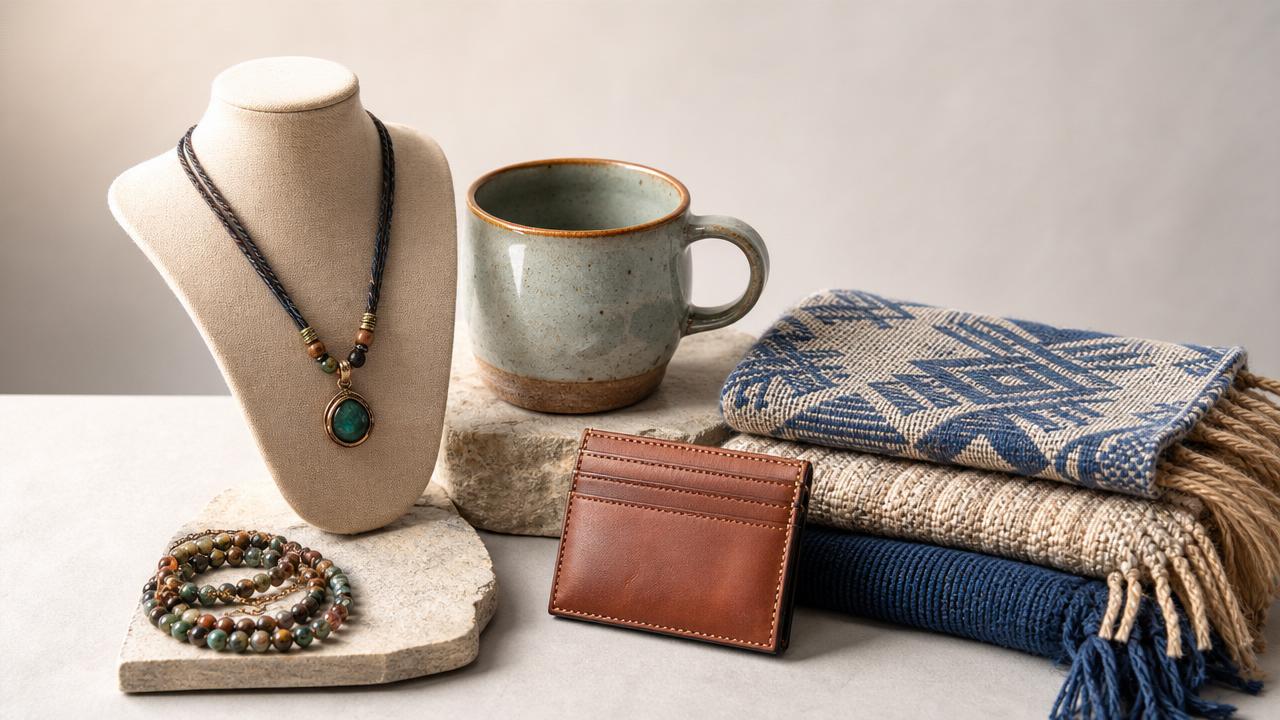
Consumers and trade buyers are both more discerning than they were 5 years ago. They increasingly ask where the item was made, what materials were used, how long production takes, and whether visible irregularities are signs of handcraft or signs of poor control. This is especially true for jewelry, embroidered accessories, hand-thrown ceramics, handwoven scarves, and vegetable-tanned leather gifts.
In practical terms, authentic handmade production often requires 3 to 12 process stages, depending on the category. A small ceramic gift may involve forming, drying, bisque firing, glazing, and second firing. A handcrafted leather wallet may require cutting, edge finishing, stitching, conditioning, and hardware setting. Process depth is one of the clearest signals of value.
Why mass-produced imitation is easy to miss
Many products marketed as artisanal are created with molds, digital pattern replication, or standardized machine stitching, then given a distressed finish or “irregular” visual effect. This does not automatically make the product poor quality, but it changes the value proposition. It is no longer a deeply handmade object, but a design-led industrial gift with artisanal styling.
For information-driven readers researching unique handmade gifts for her, the key is not to reject all scaled production. The goal is to identify what portion of the product value comes from true skill, what portion comes from materials, and what portion comes from marketing language.
The comparison below helps separate authentic craft indicators from common imitation signals across gift categories.
A practical takeaway is that real craft value is usually visible both in the hero image and in the hidden details. If quality only appears on the surface, the product may still be attractive, but it should not be priced or positioned as a truly handcrafted premium gift.
How to Evaluate Unique Handmade Gifts for Her Step by Step
A useful evaluation framework should be simple enough for retail buyers and detailed enough for sourcing decisions. Across gift, textile, leather, and home accessory categories, a 5-step review process often gives a reliable picture of whether a product deserves premium handmade positioning.
1. Check the material truth, not just the material name
Many listings use broad labels such as natural cotton, real leather, sterling finish, or artisan ceramic. These terms are not enough. Good suppliers can usually explain weight, source, composition, finish type, or treatment method within 2 to 3 lines. For example, handwoven textile gifts should clarify whether the yarn is linen, cotton, wool blend, or regenerated fiber, and whether dyeing is reactive, plant-based, or pigment-based.
In leather gifts, vegetable tanning and chrome tanning create very different aging behavior. In ceramics, stoneware and earthenware differ in density, firing temperature, and resistance to chipping. Material specificity signals that the maker or seller understands the product beyond marketing.
Questions worth asking
- What is the primary material composition by percentage or dominant base?
- Is the surface finish decorative only, or does it improve durability?
- Will the gift age, soften, patina, shrink, or fade with regular use over 6–12 months?
2. Study the making process and time logic
Authentic handmade production takes time, and the timeline should make sense. A custom embroidered pouch, hand-tooled leather journal, or hand-cast metal pendant cannot usually move from order to dispatch in 24 hours if it is truly made to order. Typical small-batch lead times range from 7 to 30 days depending on customization, drying, curing, stitching density, and inspection needs.
If a seller claims deep handcraft with unlimited stock and same-day shipment, that is a signal to investigate further. It may still be a well-made item, but probably not one built through labor-intensive artisanal methods.
3. Look for controlled variation, not random defects
One common misunderstanding is that handmade means imperfect in any way. In fact, high-quality handcraft usually shows controlled variation within a narrow tolerance. A hand-thrown cup may vary slightly in glaze pooling or rim character, but it should still sit level. A handwoven scarf may have minor texture differences, but not weak selvedges or loose yarns.
For many gift categories, a practical tolerance rule is visual variation within 5% to 10% while function remains fully reliable. When irregularity interferes with wearability, storage, closure, comfort, or stability, it is no longer artistic variation. It is a quality issue.
The table below outlines category-specific signs that help buyers distinguish artisanal character from avoidable defects.
This category lens is especially useful when comparing unique handmade gifts for her across different suppliers. It prevents buyers from overvaluing cosmetic storytelling while missing performance issues that affect returns and customer satisfaction.
4. Assess the maker’s transparency and production scale
A credible craft seller usually offers at least 3 forms of transparency: process images, realistic description of workshop capacity, and clear customization limits. For example, a small artisan studio may handle 20 to 100 units per design run, while a craft-centered workshop with semi-manual processes may support 200 to 500 units under tighter planning.
Neither scale is inherently better. The right choice depends on whether the buyer needs one-off gifts, limited seasonal collections, or branded small-batch programs. What matters is whether declared capacity aligns with the claimed handwork intensity.
5. Review packaging, care guidance, and post-sale readiness
Real craft value continues after purchase. Premium handmade gifts should arrive with protective packaging suited to the material, plus concise care instructions. A handwoven textile may need washing guidance. A ceramic piece may need food-safe or dishwasher-use clarification. Leather gifts should note storage, conditioning frequency, and moisture exposure limits.
From a B2B viewpoint, care information can reduce preventable complaints by addressing 3 common friction points: misuse, unrealistic expectations about natural aging, and confusion between character marks and defects.
Common Buying Mistakes When Researching Handmade Gifts
Even experienced buyers can misread handmade value if they rely too heavily on visual style or emotional storytelling. In gifts and lifestyle categories, there are several recurring mistakes that distort decision quality and lead to weak assortment choices.
Mistake 1: Equating higher price with higher craft content
Price often reflects branding, packaging, channel markup, or scarcity positioning. It does not automatically reflect more hours of hand labor. Two products priced within a 20% range may have very different craft structures: one may use premium raw materials with limited handwork, while the other may use simpler materials but extensive manual skill.
Mistake 2: Treating every variation as proof of authenticity
Irregularity alone is not enough. Genuine handcraft balances uniqueness with usability. A gift should still open smoothly, wear comfortably, store properly, and survive normal use. Buyers should separate aesthetic variation from structural inconsistency.
Mistake 3: Ignoring supply chain fit for repeat orders
A beautiful product is not always a scalable product. Retailers and sourcing managers need to know whether the maker can reproduce the same design in a second or third batch within 2 to 8 weeks, while maintaining acceptable visual continuity. This is especially relevant for holiday gift capsules, museum assortments, or design-store restocking.
A practical screening checklist
- Request close-up images of seams, edges, backs, linings, or underside surfaces.
- Ask for lead time by quantity tier, such as 20, 100, and 300 units.
- Confirm material behavior after use, washing, wear, or seasonal storage.
- Check whether customization affects color, dimensions, packaging, or MOQ.
- Verify how defects are defined and handled during inspection.
These steps improve decision quality for anyone comparing unique handmade gifts for her as a category, not just as a single item. They also support stronger assortment planning for brands that want gifts with story, substance, and repeatable quality.
Building a Better Sourcing Strategy for Craft-Led Gift Categories
For professional buyers and market researchers, the most effective approach is to combine aesthetic review with industrial logic. Handmade value should be evaluated through design language, material science, production feasibility, and service readiness. This is where cross-sector insight matters, especially when gifts overlap with textiles, homeware, leather, and lifestyle accessories.
Use a balanced scorecard instead of a single “artisanal” claim
A balanced review model may assign 25% to design and originality, 25% to material integrity, 20% to craftsmanship execution, 15% to packaging and care support, and 15% to supply reliability. This helps teams compare products objectively, especially during seasonal curation or private-label development.
This method is useful because the best unique handmade gifts for her are not always the most ornate. Often, the strongest products are those with a clear use case, durable construction, and a craft story that can be explained honestly in fewer than 100 words.
Match product type to recipient expectations
Not every handmade gift serves the same emotional or functional role. Jewelry and leather goods often emphasize daily wear and patina. Handwoven textiles combine utility with tactile identity. Ceramics and home accessories lean into ritual, display, and domestic atmosphere. Better sourcing decisions begin by defining whether the gift is commemorative, collectible, practical, or lifestyle-enhancing.
Keep documentation simple but precise
A strong product page, line sheet, or sourcing brief does not need excessive language. It should state 5 essentials clearly: material, process, dimensions, lead time, and care. If applicable, it should also explain acceptable variation ranges and customization options. This level of clarity supports both end-customer trust and internal purchasing alignment.
In a market crowded with decorative claims, clarity itself becomes a value signal. Buyers who evaluate gifts this way are more likely to identify authentic makers, avoid low-substance imitation, and build assortments that hold both aesthetic and commercial value.
Final Guidance for Information-Driven Buyers
The real test of unique handmade gifts for her is not whether they look charming in a single image. It is whether the product can prove its value through materials, process, variation control, durability, and maker transparency. When those elements align, the gift carries more than sentiment. It carries substance.
For brands, sourcing teams, and retail curators working across gifts, textiles, leather, and lifestyle categories, better craft evaluation leads to better product stories, fewer quality disputes, and stronger long-term positioning. If you want to refine your gift sourcing strategy, compare artisan supply options, or understand how craftsmanship translates into market value, contact us to explore more solutions, request tailored guidance, or discuss product details for your next collection.