
Office furnishing buying guide to estimating your total costs

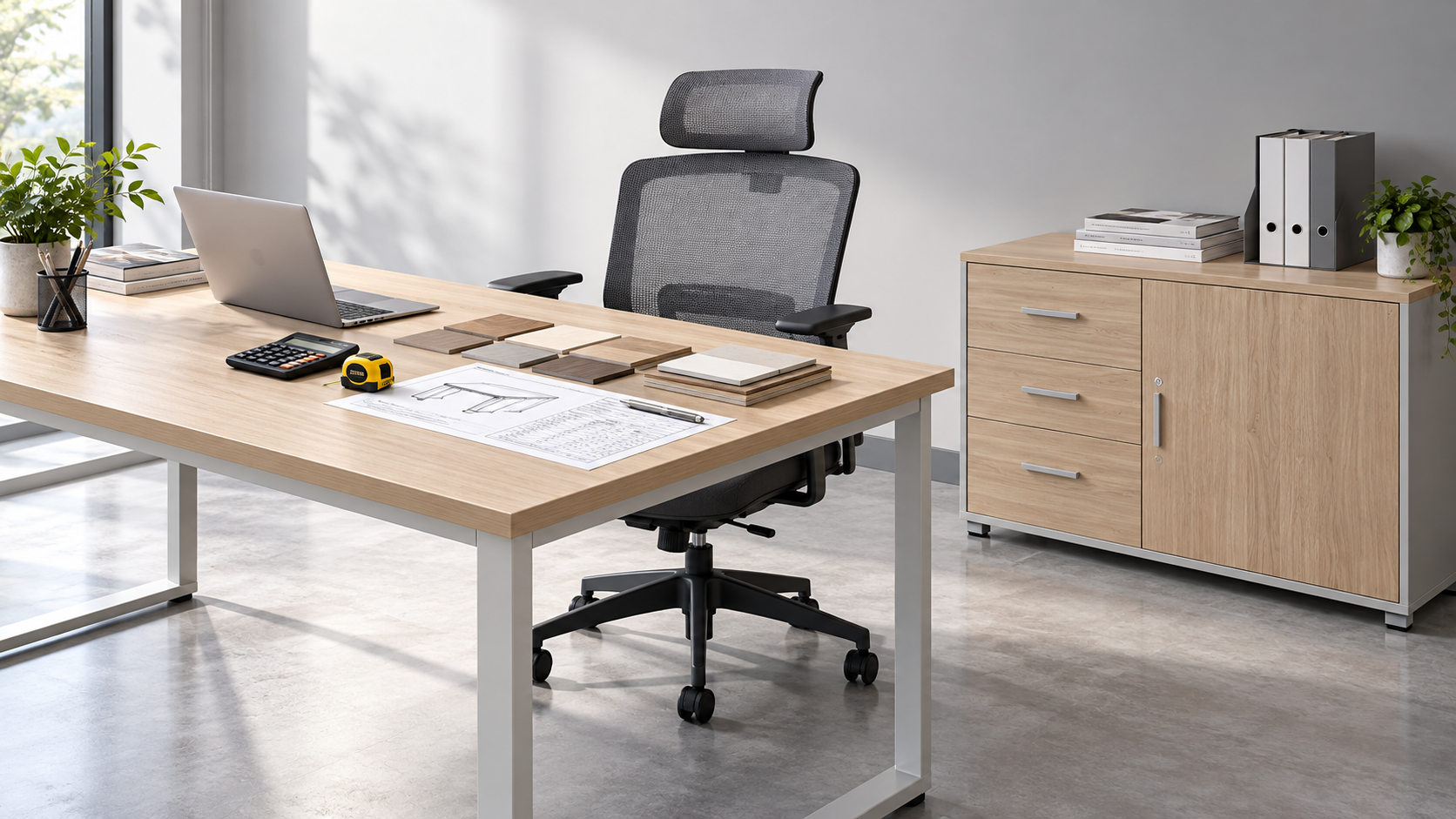
A low furniture quote is not a low office furnishing budget. The figure that matters is the cost of getting the agreed layout delivered, installed, safe to use, and supported over its planned service life. Freight, site access, electrical work, taxes, storage, and replacement parts can change which proposal offers better value.
A reliable estimate therefore needs two separate totals: the cash required to make the office operational and the expected cost of ownership over a defined period. Keeping these figures distinct prevents a cheaper initial purchase from concealing higher maintenance costs—and prevents long-term savings claims from obscuring immediate funding requirements.
Establish what must be furnished before pricing it
Headcount alone is an unreliable basis for estimating furniture quantities. A company with 80 employees does not automatically need 80 identical workstations, but a shared-desk arrangement should not be priced from average attendance alone. Peak occupancy, overlapping team schedules, assigned seating, accessibility needs, and room availability determine the usable requirement.
Build the quantity schedule from an approved layout. Separate individual workstations, meeting rooms, quiet-work areas, reception, storage, and shared spaces. Count meeting and visitor chairs independently from task chairs; combining them into one seating allowance hides differences in adjustment, durability, and intended use.
For each item, record enough detail to make supplier quotations comparable:
- Dimensions, quantity, finish, and intended location.
- Required functions, such as height adjustment, lockable storage, or cable management.
- Included accessories, including monitor arms, desk screens, power modules, and linking components.
- Performance requirements and evidence needed for acceptance.
- Whether the item is new, reused, refurbished, or relocated.
Existing furniture should only reduce the purchase budget after an inventory confirms its condition, dimensions, compatibility, and relocation cost. A reusable desk can still require dismantling, transport, replacement fixings, and reassembly. Its acquisition cost may be zero; its installed cost is not.
Keep furniture costs separate from wider fit-out expenditure, but identify the interfaces. Desk-mounted power modules may be included in the furniture package while the circuits supplying them are not. Acoustic booths may require checks on ventilation, electrical connections, fire safety, and building approval. Excluding these interfaces from the furniture contract does not remove them from the project budget.
Compare installed costs, not product subtotals
The most useful office furnishing buying guide starts with a consistent cost boundary. Every proposal should be converted into a price for the same quantities, specifications, delivery location, installation conditions, and completion requirements.
A supplier offering delivery to a loading bay is not quoting the same service as one offering placement and assembly on an upper floor. Likewise, “installation included” may exclude wall fixing, electrical connections, after-hours work, or the return visit needed to resolve defects.
Ask suppliers to identify inclusions, exclusions, assumptions, and unit rates for changes. An unpriced exclusion is an unresolved budget item—not a saving.
Use an estimate that shows where uncertainty sits
The following hypothetical budget illustrates the calculation for an office with 40 workstations and associated shared spaces. The figures are arithmetic examples in US dollars, not market benchmarks or recommended spending levels.
Here, the furniture subtotal understates the funding requirement by $23,500. That difference is a consequence of the stated assumptions, not a general industry percentage. A local delivery into an empty ground-floor office and an imported order installed in an occupied tower require different allowances.
Dividing the total by 40 produces a project cost per workstation of $2,037.50, but that figure includes shared furniture and execution costs. It should not be compared with another supplier’s desk-and-chair price. Cost-per-seat comparisons only work when their scope and seat definitions match.
Calculate taxes according to the relevant jurisdiction and transaction structure rather than copying the example allowance. Recoverable VAT or similar taxes may affect cash flow without becoming a permanent project cost. Show recoverable tax separately so that funding needs and net expenditure remain visible.
Resolve freight and installation assumptions before approving the order
For cross-border purchases, the quoted trade term and named place determine which transport obligations and costs sit with each party. EXW, FOB, and DDP prices are not directly comparable. Incoterms allocate specified delivery responsibilities, costs, and risks; they do not by themselves settle payment terms, ownership transfer, installation, or product acceptance.
Obtain a landed-cost estimate covering the actual shipment. Freight depends on packed volume, weight, route, handling requirements, and shipment configuration—not simply the number of desks. Flat-packed products can reduce shipping volume while increasing assembly work. Fully assembled products can shift that balance in the other direction.
Customs classification, origin, declared value, and destination rules affect duty and clearance costs. Confirm these with a qualified customs provider before treating an overseas quotation as a firm delivered budget. Where payment and purchasing currencies differ, record the exchange-rate assumption and the portion of the order still exposed to currency movements.
At the building, verify loading-bay bookings, lift dimensions, access routes, floor protection, installation hours, and insurance requirements. Check whether the largest components will fit through doors and lifts before ordering. Restricted access can turn a straightforward delivery into additional handling, smaller shipments, or a revised product specification.
Timing also has a cost. If furniture arrives before the site is ready, storage and repeat delivery may be chargeable. If it arrives late, temporary furniture and additional installation visits may be needed. Agree who authorizes these costs, how they are calculated, and which party bears them under the contract.
Spend on specifications that change service life or usability
Value engineering should remove unnecessary cost without weakening the functions the office needs. Matching every visible finish precisely may be less valuable than preserving chair adjustability, robust desk hardware, or replaceable components.
For task seating, assess the adjustment range against intended users and working patterns. A chair with numerous controls is not automatically suitable if its seat dimensions or adjustment limits exclude users. Samples allow fit, operation, and build details to be checked before a large order; any sample approval should identify the exact configuration being purchased.
For desks and storage, compare construction rather than material labels alone. Board thickness, edge treatment, joint design, hardware, surface finish, and the ability to survive disassembly all influence suitability. A generic description such as “commercial grade” is not a measurable acceptance criterion.
Request evidence against relevant standards where required, and check its scope. ANSI/BIFMA X5.1, for example, addresses tests for general-purpose office chairs; it does not establish that every chair will fit every user. Reports should match the proposed model and configuration. Environmental or emissions documentation likewise needs to cover the relevant product or materials and satisfy applicable project requirements.
Standardizing finishes, desk sizes, and hardware can simplify spares and future moves. Excessive standardization can create another cost if it forces unsuitable furniture into rooms with different functions. The useful objective is fewer unnecessary variants, not identical furniture everywhere.
Test lifecycle value without inventing savings
Choose an ownership period that reflects the lease, expected occupancy, and likely reuse of the furniture. A long theoretical lifespan has limited financial value if the product cannot be relocated or adapted when the office changes.
A practical lifecycle estimate is:
Installed acquisition cost + maintenance + repairs and replacements + reconfiguration and relocation + disposal costs − supportable residual value.
Include only costs with a defensible basis. Cleaning requirements can be estimated from material care instructions and service rates. Replacement assumptions should reflect expected use, warranty limitations, repairability, and spare-part availability. Do not assign a resale value merely because a supplier describes furniture as recyclable; recyclability and resale demand are different things.
For example, a hypothetical $250 chair replaced once during the selected period creates $500 in purchase expenditure before replacement delivery and disposal. A $380 chair that lasts the period with one $40 repair costs $420 on the same simplified basis. The second option is cheaper only if those service-life and repair assumptions hold. Where timing materially affects the comparison, discount future cash flows consistently.
Read warranty coverage alongside the cost model. Check whether it includes labor, freight, on-site service, and replacement components, and whether particular mechanisms, upholstery, or usage conditions have different terms. A long warranty does not eliminate downtime or the cost of arranging service.
Turn the estimate into a controlled commitment
Contingency should correspond to unresolved risks rather than serve as an unexplained percentage. Pending site measurements, uncertain freight, incomplete layouts, and phased occupation each require different treatment. Keep known but unquoted work as a separate allowance; reserve contingency for uncertainty rather than using it to hide missing scope.
Before issuing the purchase order, reconcile the final quantities, approved samples, drawings, delivery programme, and installation scope. Record substitution rules, inspection arrangements, damage-reporting deadlines, and responsibility for correcting shortages or defects. Link payment milestones to clearly defined deliverables, subject to negotiated terms and applicable law.
The final approval should show the committed price, remaining allowances, recoverable taxes, contingency, and expected payment dates. That makes the budget usable after ordering, when layout changes, access delays, and incomplete deliveries can still alter the outcome. The strongest purchase decision is the one whose total cost remains explainable from quotation through to an operational office.


