
Modern Furniture With Storage: Space vs. Cost
For project managers balancing fit-out budgets, timelines, and long-term usability, modern furniture with storage is more than a design preference.
It is a space-planning decision with measurable cost impact across offices, hospitality spaces, residential projects, and flexible commercial environments.
The right solutions can reduce clutter, improve workflow, and maximize every square foot, but added functionality changes procurement and maintenance assumptions.
This article explains how to evaluate space savings against total cost, so project leaders can choose furniture that supports aesthetics and efficiency.
The Real Question: Does Storage Furniture Save Enough Space to Justify the Cost?
For most projects, the answer is not simply yes or no. It depends on what the space must perform over time.
Modern furniture with storage often costs more upfront than standard furniture, especially when mechanisms, modular parts, or custom dimensions are involved.
However, the additional cost may be justified if it reduces built-in cabinetry, lowers clutter, improves circulation, or delays future expansion.
Project managers should avoid judging storage furniture only by unit price. The better comparison is total cost per usable function.
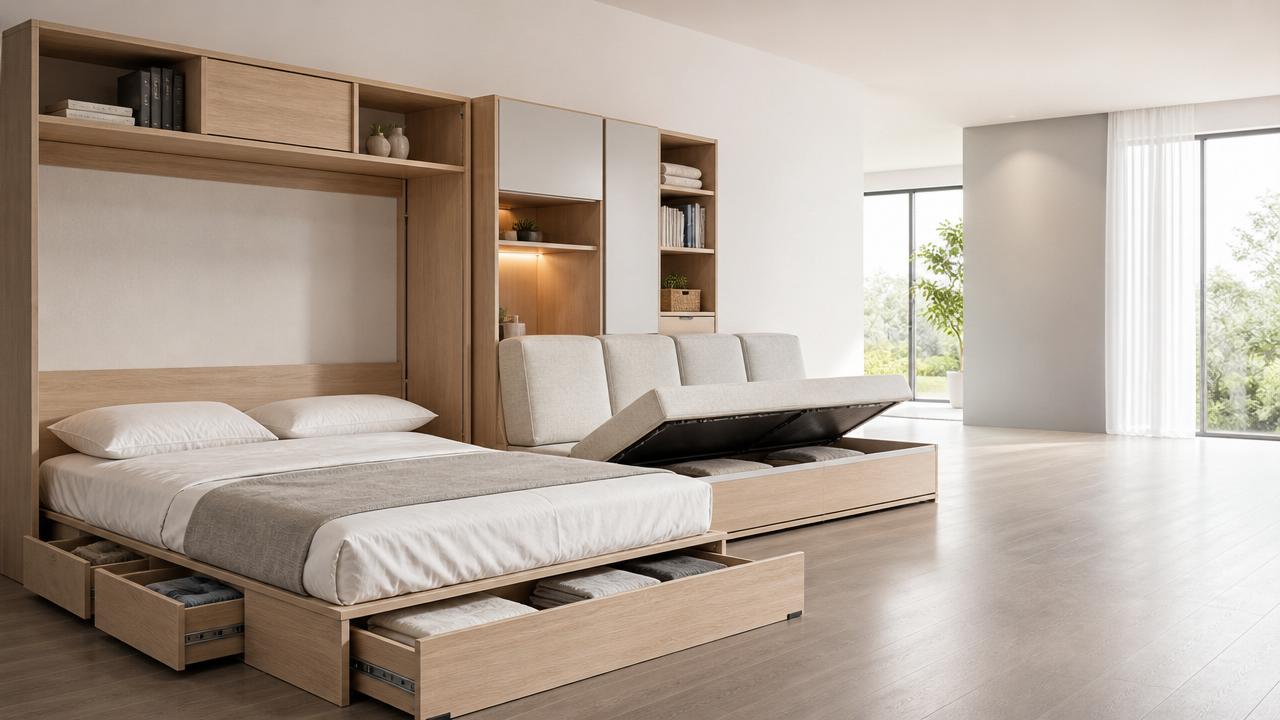
A storage bench, for example, may replace seating, shelving, and a circulation problem in one compact footprint.
In dense projects, that combined value can be more important than the price difference between two individual furniture pieces.
Why Project Managers Should Treat Storage as a Space Asset
Floor area is one of the most expensive resources in any built environment, whether leased, purchased, renovated, or operated.
When furniture adds storage, it can convert underused zones into productive capacity without changing the building envelope.
This matters in open offices, co-working areas, staff lounges, hotel rooms, serviced apartments, clinics, and education facilities.
Storage-integrated furniture helps teams manage materials, personal items, devices, linens, documents, samples, or operational supplies near the point of use.
That proximity reduces wasted movement, supports cleaner spaces, and lowers the chance that ad hoc storage will damage the design intent.
For project delivery, the value is practical: fewer loose cabinets, fewer afterthought purchases, and fewer complaints after handover.
Where the Cost Increase Usually Comes From
The cost premium for modern furniture with storage is rarely about storage volume alone. It comes from construction complexity.
Drawers, lift-up lids, sliding panels, hinges, soft-close runners, locking systems, cable access, and reinforced frames all add manufacturing cost.
Materials also matter. Engineered wood, metal frames, laminated surfaces, acoustic panels, and upholstery each affect price and durability differently.
Custom sizing can increase cost further, especially when furniture must align with columns, partitions, power points, or brand-specific finishes.
Installation may also be more involved if units require anchoring, leveling, wall protection, concealed wiring, or coordination with other trades.
For accurate budgeting, separate the furniture cost, delivery cost, installation cost, spare parts, and expected maintenance requirements.
The Space-Saving Value Is Highest in These Project Scenarios
Storage furniture delivers the strongest return where space is constrained, activities change frequently, or users need fast access to stored items.
In offices, mobile pedestals, storage walls, lockers, and benching systems can reduce clutter without adding dedicated storage rooms.
In hospitality projects, beds with drawers, luggage benches, and concealed minibar units improve guest experience within compact room layouts.
In multi-family developments, storage sofas, modular wardrobes, and foldaway desks help developers market smaller units as more livable.
In education and training spaces, storage-integrated tables and seating help rooms switch quickly between lectures, workshops, and group activities.
In clinics or wellness spaces, concealed storage can support hygiene, visual calm, and workflow without overloading corridors or treatment rooms.
When Standard Furniture May Be the Smarter Choice
Not every project needs furniture with integrated storage. In some cases, it can add cost without solving a real operational problem.
If a facility already has efficient back-of-house storage, extra compartments may remain unused while increasing cleaning and inspection time.
Standard furniture may also be preferable where layouts change often and storage needs are unpredictable or better handled by mobile units.
For high-turnover spaces, complicated mechanisms may create avoidable maintenance issues if users are unfamiliar or careless.
Projects with tight opening dates should also consider whether custom storage furniture creates procurement risk or longer lead times.
The key question is whether storage supports a defined use case, not whether it looks efficient in a product catalog.
How to Compare Space Savings Against Total Cost
A practical evaluation starts with mapping what must be stored, who needs access, how often, and where use occurs.
Next, estimate the space currently occupied by separate shelves, cabinets, trolleys, closets, or unmanaged piles of items.
Then compare the footprint of storage-integrated furniture with the footprint of separate furniture plus dedicated storage circulation.
This method gives project managers a clearer view of real space gain, not just the internal storage capacity of a product.
Cost comparison should include purchase price, freight, installation, cleaning access, replacement parts, expected damage, and lifecycle duration.
Where possible, calculate cost per square foot released or cost per operational problem solved, rather than cost per item purchased.
Procurement Criteria That Matter Beyond Appearance
Appearance matters, but project managers should evaluate modern furniture with storage through performance criteria before approving selections.
Check load capacity, hardware quality, edge protection, moisture resistance, fire compliance, warranty coverage, and ease of replacement.
For commercial spaces, specify contract-grade components rather than residential-grade alternatives, especially for drawers, hinges, and sliding systems.
Ask suppliers for test data, material specifications, maintenance guidance, and references from similar project environments.
Also verify whether storage compartments are easy to clean, accessible for different users, and safe during repeated daily operation.
A beautiful storage unit that fails after six months can quickly become more expensive than a simpler, better-built solution.
Design Coordination: Avoiding Hidden Costs During Installation
Many cost overruns occur because storage furniture is selected after mechanical, electrical, or architectural decisions are already fixed.
Early coordination helps ensure that power access, wall clearances, door swings, skirting, ventilation, and floor levels are compatible.
Storage furniture near workstations may need cable ports, charging access, privacy screening, or acoustic treatment integrated from the start.
Built-in or semi-built-in pieces require precise site dimensions, tolerance checks, and alignment with finishes before manufacturing begins.
Project managers should confirm responsibility boundaries between furniture suppliers, contractors, designers, electricians, and facility teams.
Clear shop drawings and mockups can prevent expensive rework, especially where modular storage units meet walls, glazing, or fixed joinery.
Lifecycle Cost: Maintenance, Flexibility, and Replacement
The most economical choice is not always the cheapest purchase, but the one that remains useful through the project lifecycle.
Furniture with integrated storage should be assessed for cleaning access, hardware replacement, panel repair, and adaptability to future layouts.
Modular systems often offer better lifecycle value because damaged sections can be replaced without removing an entire installation.
Standardized dimensions and components also simplify future procurement, especially for phased rollouts across multiple locations.
In contrast, highly customized storage furniture may deliver excellent fit initially but become costly when operations change.
For long-term assets, flexibility should be treated as financial protection, not only as a design preference.
User Behavior Determines Whether Storage Actually Works
Storage capacity has limited value if users do not understand where items belong or find compartments inconvenient.
Project managers should involve facility managers, department leads, housekeeping teams, or end users before finalizing specifications.
Observe daily routines and identify whether people need open shelves, lockable drawers, shared lockers, concealed bins, or mobile storage.
In offices, personal storage can reduce desk clutter, but shared project storage may be more valuable for collaborative teams.
In hospitality, concealed storage must not confuse guests or slow cleaning teams during room turnover.
The best storage furniture feels intuitive, reduces friction, and supports real behavior instead of forcing users into unrealistic routines.
Sustainability and Supply Chain Considerations
For GLC’s global lifestyle and craftsmanship perspective, storage furniture should also be reviewed through sustainability and supply chain quality.
Longer-lasting furniture reduces waste, especially in commercial projects where damaged low-cost items are frequently replaced.
Project teams should consider certified wood, recycled materials, low-emission finishes, repairable hardware, and suppliers with transparent manufacturing standards.
Flat-pack solutions may reduce freight volume, but they must still meet durability expectations for the intended environment.
Local or regional sourcing can shorten lead times, reduce transportation risk, and support better after-sales service.
Sustainability is strongest when material responsibility, craftsmanship, repairability, and operational usefulness are evaluated together.
A Practical Decision Framework for Project Leaders
Before approving modern furniture with storage, project managers can use a simple decision framework to avoid subjective choices.
First, define the operational problem: clutter, lack of personal storage, limited floor area, inefficient workflow, or poor guest usability.
Second, estimate the measurable benefit, such as reduced furniture count, released floor area, faster room turnover, or improved workstation efficiency.
Third, compare lifecycle cost against standard furniture plus separate storage, including installation and maintenance assumptions.
Fourth, test user access, safety, cleaning, and durability through samples, mockups, or supplier demonstrations when possible.
Finally, confirm whether the solution remains adaptable if occupancy, service models, or room functions change later.
Common Mistakes That Lead to Poor ROI
One common mistake is buying storage furniture because it looks multifunctional, without verifying whether the storage is accessible.
Another mistake is underestimating hardware quality, especially in high-use projects where cheap runners and hinges fail quickly.
Some teams also over-customize early, locking themselves into dimensions that make replacement difficult or expensive.
Others ignore cleaning and maintenance, creating hidden compartments that collect dust, waste time, or become neglected.
A final mistake is treating furniture as decoration rather than operational infrastructure that affects productivity and lifecycle cost.
Avoiding these issues requires early planning, realistic user insight, and procurement discipline beyond visual approval.
Conclusion: Balance Space, Cost, and Operational Value
Modern furniture with storage is most valuable when it solves a measurable space or workflow problem, not when it merely adds features.
For project managers, the right decision depends on total cost, usable floor area, durability, maintenance, and future flexibility.
Choose integrated storage where it reduces clutter, eliminates separate furniture, supports daily operations, or improves user experience.
Choose simpler furniture where storage needs are minimal, uncertain, or better handled by dedicated systems.
The strongest projects balance aesthetics with craftsmanship, budget control, and practical performance over the full life of the space.
When evaluated this way, storage furniture becomes a strategic planning tool rather than a premium design accessory.