Climbing Equipment Safety Standards to Check in 2026

As safety expectations and global compliance rules continue to evolve, technical evaluators must take a sharper look at climbing equipment before 2026. From load-bearing performance and material durability to certification updates and traceability, understanding the latest climbing equipment safety standards is essential for accurate assessments, risk reduction, and informed sourcing decisions across the outdoor industry.
Climbing equipment safety standards are entering a stricter phase
The outdoor sector is no longer judging climbing equipment only by basic strength or familiar branding. In 2026, compliance depth will matter as much as performance claims.
More buyers now compare climbing equipment through testing consistency, batch traceability, environmental exposure resistance, and certification relevance across export markets.
This shift reflects a broader industry pattern. Aesthetic appeal and technical design still matter, but measurable safety proof now shapes product credibility.
For a platform focused on craftsmanship and industrial standards, this transition highlights how product intelligence must connect field use, lab data, and supply chain discipline.
Several market signals show why climbing equipment reviews must change
The safety conversation around climbing equipment is expanding because outdoor use scenarios are becoming more diverse, technical, and internationally regulated.
Indoor climbing growth also influences expectations. New users often move between gyms, guided routes, and outdoor terrain, increasing scrutiny on gear reliability.
At the same time, digital retail has made product comparison easier. Safety labels, standards references, and test details are now visible decision factors.
- More cross-border sales require alignment with EN, UIAA, and market-specific documentation.
- Product recalls have increased attention on traceability and lot-level accountability.
- Material innovation brings benefits, but also demands deeper validation under real stress conditions.
- Sustainability claims now face pressure to prove they do not reduce safety margins.
The main forces behind 2026 climbing equipment standards can be mapped clearly
The tightening of climbing equipment safety standards is not random. It is being driven by technical, legal, environmental, and commercial pressures.
What to check first when evaluating climbing equipment in 2026
Not every checkpoint carries equal weight. The most reliable evaluation starts with the technical areas that most directly affect user safety and legal defensibility.
1. Load-bearing performance must be verified by product type
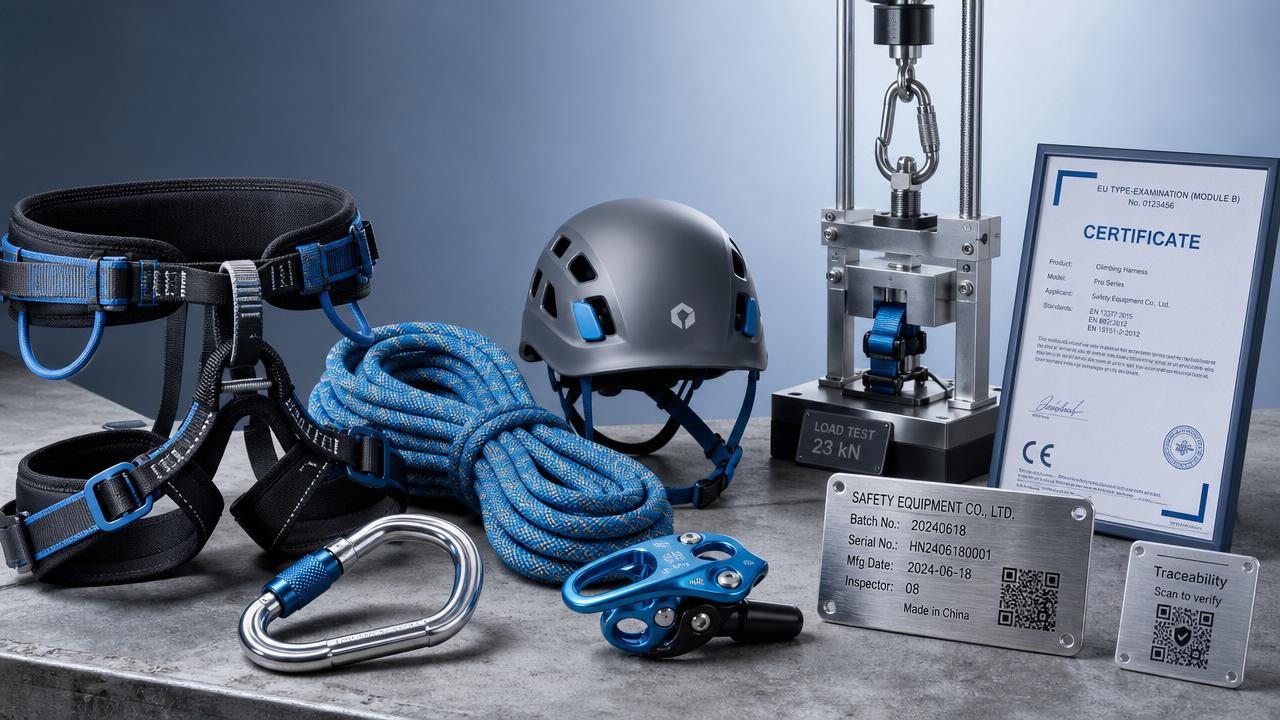
Different climbing equipment categories need different benchmark checks. Harnesses, carabiners, ropes, helmets, belay devices, and anchors should never share generic evaluation logic.
Review static strength, dynamic performance, gate function, elongation behavior, impact energy handling, and deformation tolerance where applicable.
2. Material durability needs aging-based validation
Climbing equipment often passes new-condition tests, but aging changes the picture. UV, dirt, moisture, repeated loading, and friction can reduce safety margins.
Check whether testing includes simulated wear, corrosion resistance, textile fray behavior, coating stability, and long-term storage performance.
3. Certification must match actual market use
A certificate alone is not enough. The climbing equipment configuration, labeling, revision date, and stated application must match the product being sold.
This matters especially for private label production, mixed-component systems, and products promoted for multiple outdoor scenarios.
4. Traceability is becoming a core safety requirement
By 2026, traceability will strongly influence trust in climbing equipment. Batch codes, production dates, test records, and supplier consistency should be easy to confirm.
Without traceability, even good products become harder to defend during audits, complaints, incident reviews, or cross-border inspections.
The impact reaches design, sourcing, testing, and brand reputation
Stricter climbing equipment standards affect more than laboratories. They change how products are designed, how materials are selected, and how quality stories are communicated.
Design teams may need to simplify risky structures, improve compatibility guidance, and document intended use more precisely.
Sourcing teams may face tighter control over metal treatment, webbing quality, stitching consistency, resin behavior, and subcontractor transparency.
Testing partners will need broader protocols. Standard pass results alone may no longer satisfy customers seeking real-world confidence.
- Better safety data can improve listing performance and reduce dispute risk.
- Weak documentation can damage brand trust faster than minor cosmetic defects.
- Well-managed climbing equipment programs support premium positioning in outdoor leisure markets.
The most important watchpoints for businesses and technical teams
The following priorities deserve close attention when reviewing climbing equipment ahead of 2026.
- Confirm the latest applicable EN and UIAA references for each product category.
- Check whether test samples represent final mass-production conditions.
- Verify compatibility among components marketed as a system.
- Review labeling clarity for lifespan, inspection frequency, and retirement criteria.
- Evaluate supplier controls for textile, metal, plastic, and finishing processes.
- Assess whether recycled or bio-based materials affect durability or consistency.
- Require documented corrective action procedures for failed batches.
A practical response plan can reduce risk before new issues appear
A forward-looking approach to climbing equipment should combine standards review, physical testing, and supply chain visibility.
Why this matters for the broader lifestyle and craftsmanship economy
Climbing equipment is part of a larger outdoor lifestyle ecosystem where quality living depends on trust, design intelligence, and disciplined production.
In this sense, safety standards are not only technical barriers. They also reflect how craftsmanship quality becomes visible in global trade.
As outdoor leisure products move toward higher value segments, climbing equipment with verified safety performance will stand out more clearly.
That makes compliance intelligence a strategic asset, especially where design, material innovation, and manufacturing credibility must work together.
The next move is to audit climbing equipment against future-ready criteria
The safest next step is not waiting for a problem. Review current climbing equipment files, compare them with 2026 expectations, and identify weak points now.
Start with high-risk categories, verify test relevance, inspect traceability depth, and update technical communication across every sales channel.
In a market shaped by quality, aesthetics, and accountability, stronger climbing equipment standards are becoming a foundation for durable growth.