How to Compare Climbing Equipment Suppliers in Europe

Why is comparing climbing equipment Europe suppliers now more complex?
Choosing a supplier in climbing equipment Europe affects far more than unit cost. It shapes compliance, safety perception, launch timing, and the credibility of every outdoor product line.
That is why the comparison process has become more detailed. Buyers now weigh factory discipline, testing standards, materials, and responsiveness with the same attention once reserved for price sheets.
In the outdoor segment, technical products carry visible risk. A weak buckle, inconsistent webbing, or unclear batch traceability can quickly become a brand problem.
A practical review should also look beyond the product itself. The strongest suppliers usually connect design intent, craftsmanship, and production control in one stable system.
This is where market intelligence matters. Platforms such as GLC are useful because they read outdoor products through both aesthetic and industrial lenses, not as isolated catalog items.
For climbing equipment Europe sourcing, that broader view helps explain why two similar products can perform very differently once scaling, certification, and delivery pressure enter the picture.
What should you compare first when screening a new supplier?
Start with product scope and technical fit. Not every outdoor factory with metalworking or sewing capacity is truly capable of climbing equipment Europe production.
A supplier may look strong in camping hardware yet be unsuitable for load-bearing climbing products. The first question is simple: what exactly do they produce repeatedly and safely?
The next layer is documentation. Ask for product categories, applicable standards, test records, quality procedures, and a clear explanation of subcontracted processes.
In actual sourcing work, the most revealing signals often appear early. Slow technical replies, vague specification language, or missing revision control usually indicate later execution issues.
A useful first-round checklist includes the following points:
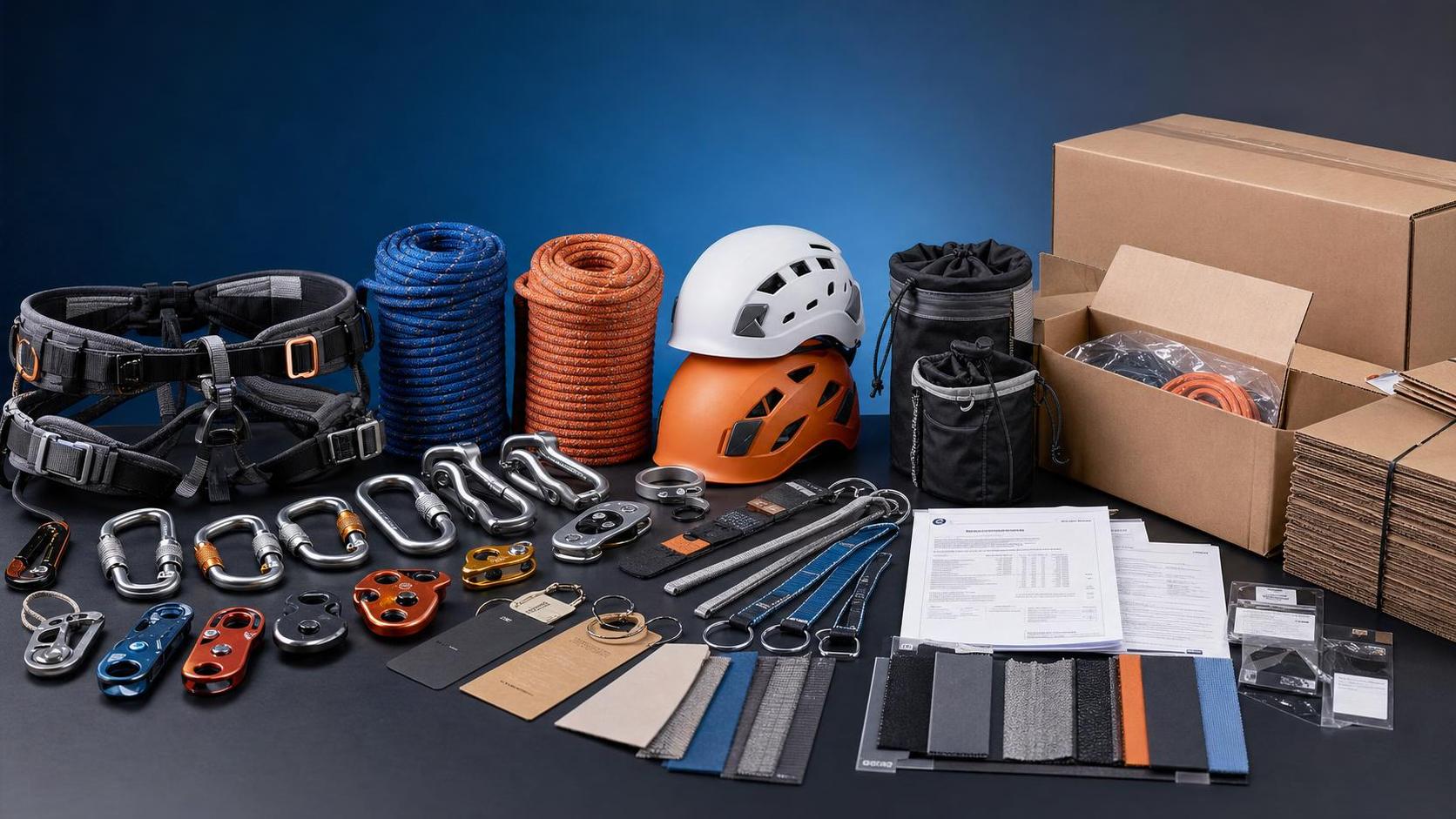
- Relevant experience in harnesses, ropes, helmets, carabiners, belay devices, or climbing textiles.
- Documented compliance with applicable EN or UIAA-related requirements where relevant.
- Traceability of raw materials, metal alloys, webbing, stitching threads, and coatings.
- In-house testing capability or stable access to accredited third-party laboratories.
- Defined lead times for samples, pilot runs, and repeat orders.
This early filter saves time. It narrows the field to suppliers that can support serious climbing equipment Europe programs instead of only quoting attractively.
Which certifications and compliance signals actually matter?
Certification should be read carefully, not treated as a marketing badge. In climbing equipment Europe sourcing, the key issue is whether the certificate matches the exact product category and production reality.
For example, a factory may hold a quality management certificate, yet that alone says little about the performance of carabiners or sewn safety components.
More useful questions include: Which standard applies to this item? Who tested it? Was testing done on a representative production sample? How often is conformity reviewed?
Because GLC follows both craftsmanship and industrial standards across outdoor and lifestyle sectors, this kind of cross-checking is essential. Material beauty and product feel matter, but safety evidence matters more.
The table below helps separate strong signals from weaker ones during climbing equipment Europe supplier comparison.
The point is not to collect the most paperwork. It is to confirm that the supplier can prove consistency under real production conditions.
How do you judge manufacturing capability beyond the sample room?
Samples can be misleading. A polished prototype may come from a senior technician, while bulk production depends on standardization, operator training, machine maintenance, and process discipline.
For climbing equipment Europe sourcing, the better question is whether the factory can repeat the same safety and finish level at scale.
Look at the production route. Metal products need stable forging, machining, heat treatment, surface finishing, and load testing. Soft goods need controlled cutting, bartacking, pattern accuracy, and seam consistency.
It is also worth checking how design requests move into production. Suppliers that bridge aesthetics with engineering usually handle specification changes more cleanly.
That matters in Europe, where outdoor brands increasingly expect products to combine technical credibility with refined finishing, sustainable materials, and clear retail presentation.
When comparing factories, ask for evidence in these areas:
- Capacity by process, not only by monthly unit volume.
- Failure rates, rework levels, and corrective action records.
- Operator specialization for technical outdoor products.
- Pilot-run stability before full purchase order release.
- Ability to source recycled, bio-based, or low-impact materials without uncontrolled substitutions.
A supplier with moderate scale but strong process control often outperforms a larger factory with weak technical governance.
Is price still useful, or does it hide more than it reveals?
Price still matters, but it only becomes meaningful after technical alignment. A low quote in climbing equipment Europe can reflect shortcuts in alloy grade, webbing source, coating durability, packaging protection, or inspection depth.
More often, the real cost gap appears later. Delays, failed tests, inconsistent dimensions, and urgent air freight can erase any initial savings.
A better comparison method is landed and managed cost. That means including tooling, certification updates, sample loops, defect exposure, logistics flexibility, and communication efficiency.
Lead time should be reviewed the same way. A short quoted lead time is not enough if the supplier depends on unstable subcontractors or imported materials with uncertain availability.
In practice, these questions make the quotation review far more useful:
- What assumptions sit behind the quote?
- Which materials are fixed, and which remain open?
- How are test failures, rework, and replacement shipments handled?
- What is the reorder lead time during peak outdoor season?
- Can the supplier support phased deliveries across multiple markets?
When these answers are clear, price becomes a decision tool instead of a trap.
What mistakes are common when comparing climbing equipment Europe partners?
One common mistake is overvaluing trade show presentation. A strong booth or premium sample set may reflect design polish, but not necessarily production reliability.
Another is assuming outdoor experience is transferable across categories. A supplier strong in tents or bags may not be ready for climbing safety hardware.
Some teams also compare suppliers using inconsistent documents. If one factory prices a complete technical pack and another quotes from images or verbal notes, the comparison is already distorted.
There is also a softer risk: ignoring how a supplier thinks. The best partners ask precise questions, challenge unrealistic tolerances, and flag sourcing risks early.
That behavior often signals maturity. It aligns with the GLC view that craftsmanship is not just execution. It is the ability to connect design, materials, function, and market expectations coherently.
If the goal is long-term climbing equipment Europe sourcing, avoid these shortcuts:
- Choosing on price before validating technical equivalence.
- Accepting certifications without product-specific review.
- Skipping pilot production because the sample looked fine.
- Ignoring communication quality during the quotation stage.
- Treating sustainability claims as proven without supply chain evidence.
How should the final decision be made when two suppliers look similar?
When two candidates appear close, the decision usually comes down to control, not presentation. Which one provides clearer risk visibility and fewer assumptions?
At that point, a structured scorecard helps. Weight compliance fit, production repeatability, engineering response speed, traceability, cost transparency, and peak-season reliability.
It is also wise to test the relationship before scaling. A pilot order reveals far more than a sample review, especially in climbing equipment Europe programs with technical and reputational exposure.
Useful next steps are straightforward. Tighten the technical pack, align the applicable standards, compare total cost rather than headline price, and verify how the supplier manages change.
The best sourcing decisions usually come from this balanced view: design quality, industrial proof, and supply chain discipline working together.
For anyone navigating climbing equipment Europe, that approach reduces avoidable risk and creates a stronger base for long-term outdoor product development.