Supplier Certification Requirements: Key Documents and Audit Risks

Supplier certification sits at the center of modern sourcing control. In categories shaped by design, material innovation, and cross-border production, weak documentation can trigger far more than a paperwork issue.
It can delay onboarding, expose hidden labor or environmental risks, and interrupt delivery at the exact point when market demand is shifting.
That is why certification requirements for suppliers matter across textiles, apparel, furnishings, gifts, leather goods, and outdoor products. They connect compliance, product credibility, and manufacturing reliability in one practical framework.
For businesses tracking the link between global aesthetics and craftsmanship, supplier certification is not only about passing audits. It is also a way to verify whether a factory can support quality, safety, sustainability, and consistent execution.
Why Certification Standards Now Shape Sourcing Decisions
Buyers today rarely judge a supplier by price and sample quality alone. The decision increasingly depends on whether the facility can prove control over process, labor conditions, raw materials, and product claims.
This is especially visible in soft industry sectors, where style cycles are fast but reputational damage lasts longer. A fabric mill, furniture workshop, or gift packaging plant may look commercially attractive, yet still fail a customer audit.
Certification requirements for suppliers have therefore become a screening tool. They help reduce uncertainty before orders scale, and they create a common language between brands, factories, and third-party inspectors.
In practice, the value is simple. Good certificates support confidence. Poor certificates create questions that usually become cost, delay, or risk later.
What Counts as Supplier Certification
The phrase covers more than one type of approval. Some documents confirm management systems. Others verify product safety, restricted substances, social responsibility, traceability, or material origin.
Not every supplier needs the same set. Certification requirements for suppliers depend on product category, destination market, customer policy, and the claim attached to the goods.
A home textile exporter may need OEKO-TEX, ISO 9001, and social compliance records. A leather accessories maker may face chemical testing, wastewater controls, and traceability checks. Outdoor equipment often adds performance testing and labeling review.
The key point is that certification is contextual. A valid certificate only matters if it matches the real production scope and the actual compliance expectation.
The Core Documents Worth Verifying First
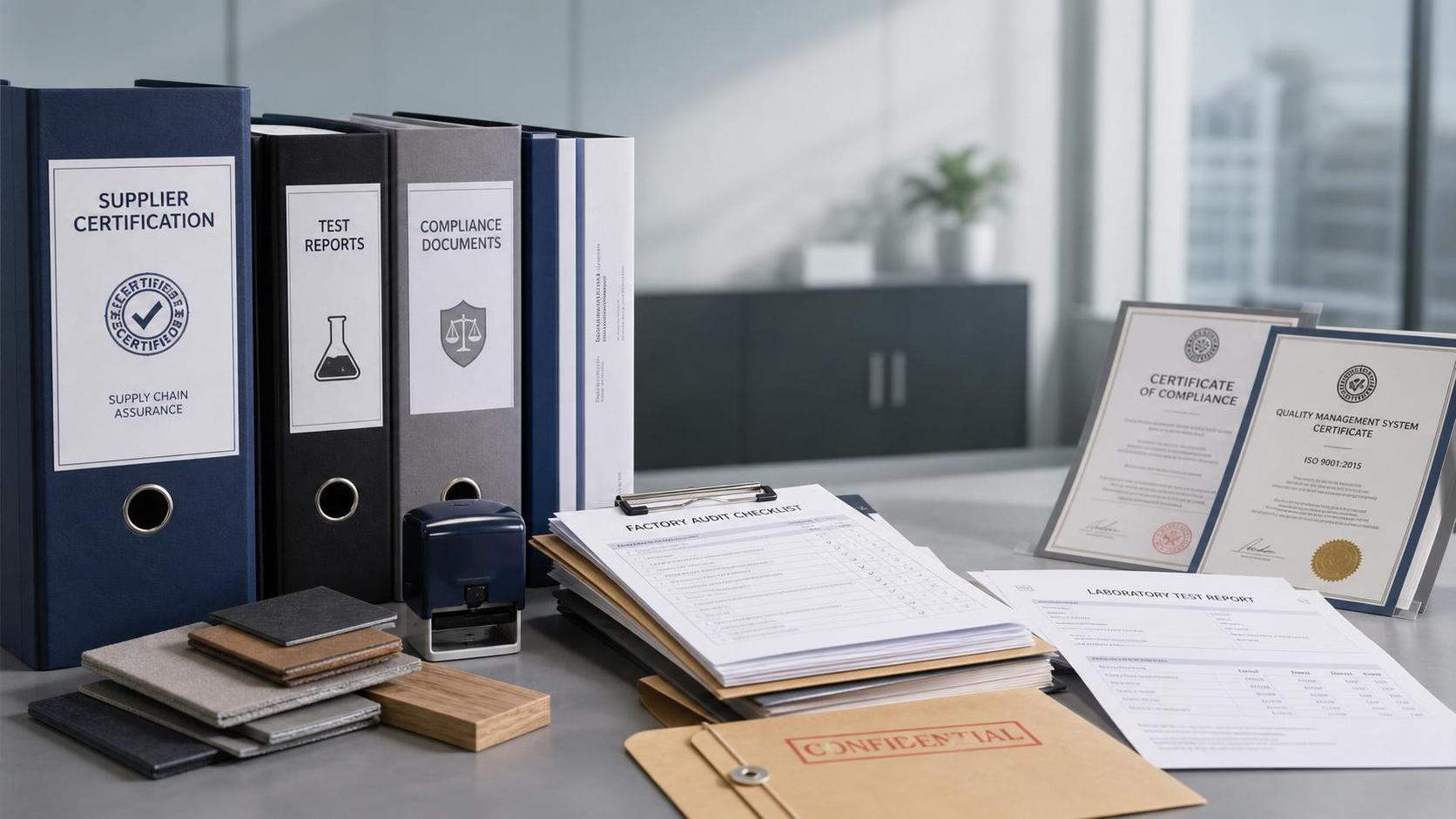
Most supplier files contain dozens of records, but a smaller group usually determines whether onboarding moves smoothly or stalls under review.
Management system certificates
- ISO 9001 for quality management and process consistency.
- ISO 14001 for environmental management structure.
- ISO 45001 for occupational health and safety controls.
These do not guarantee perfect operations, but they show whether a factory has formal systems instead of informal habits.
Social and ethical compliance records
- SMETA, amfori BSCI, SA8000, or customer-specific audit reports.
- Payroll samples, working hour records, age verification, and grievance procedures.
These documents matter because many audit failures come from site practices, not product defects.
Environmental and chemical compliance documents
- Wastewater permits, emission records, hazardous waste handling logs.
- REACH, RoHS, California Proposition 65, or restricted substance testing where relevant.
- ZDHC-related records for wet processing sectors.
Product and material-specific certificates
- OEKO-TEX, GOTS, FSC, GRS, RCS, or Leather Working Group references.
- Test reports for flammability, colorfastness, durability, load-bearing, or outdoor performance.
- Declarations of conformity, labeling files, and packaging compliance evidence.
In design-led categories, these records support both compliance and the integrity of marketing claims.
How Audit Risks Usually Appear
Audit risk rarely starts with a dramatic event. More often, it begins with small inconsistencies between what a supplier says, what the certificate covers, and what the site is actually doing.
Among these issues, scope mismatch is especially common. A certificate may belong to a parent company, another branch, or a process unrelated to the ordered goods.
Another frequent problem involves staged compliance. The supplier prepares documents for the audit, but daily controls remain weak after the visit ends.
Category Differences Across Soft Industry Supply Chains
Certification requirements for suppliers vary sharply by sector, even when buyers use the same sourcing region.
In textiles and apparel, chemical management, traceability, and social audits often dominate. Dyeing, printing, and finishing stages create higher environmental exposure and more documentation pressure.
In footwear and leather, material sourcing and restricted substances deserve closer scrutiny. Adhesives, coatings, tanning inputs, and outsourced stitching can complicate certification chains.
Office furnishing and interior products add structural testing, surface safety, and fire-related standards. For workspace products, claims around ergonomics or sustainability should also be supported by recognized evidence.
Gifts and digitally crafted items often involve mixed materials and short lead times. That creates a practical risk: fast product development can outpace compliance review.
Outdoor leisure products usually combine performance expectations with tougher regulatory checks. Water exposure, UV resistance, flame behavior, and labeling accuracy can all affect final approval.
What Strong Verification Looks Like in Practice
A useful review process goes beyond collecting PDFs. It asks whether the documents reflect the real supply chain, the real manufacturing steps, and the real compliance claims attached to the order.
- Check certificate issuer credibility and validity dates.
- Confirm the exact legal entity, site address, and covered process.
- Match test reports to current materials, not older prototypes.
- Review whether subcontractors need equivalent certification.
- Compare audit findings with corrective action evidence.
- Recheck claims used in sales sheets, labels, and digital product content.
This approach matters because certification requirements for suppliers are dynamic. Standards evolve, customer expectations change, and formerly acceptable documents may become insufficient in the next sourcing cycle.
Where Buyers Often Misjudge the Real Risk
One common mistake is treating every certificate as equal. A broad management certificate does not replace product testing, and a factory audit does not prove material traceability.
Another mistake is relying on first-tier visibility only. In many categories, the highest compliance exposure sits one level deeper, inside dye houses, tanners, component workshops, or packaging suppliers.
There is also a timing issue. Certification review often happens too late, after sample approval or price negotiation. At that stage, weak documentation becomes harder to challenge without commercial disruption.
More mature sourcing teams build the document review earlier. They use certification requirements for suppliers as a qualification gate, not as a final administrative step.
A Practical Next Step for Stronger Supplier Approval
The most useful starting point is to separate mandatory documents from risk-based documents. That creates a cleaner approval path and helps prioritize follow-up where exposure is highest.
Then map certification requirements for suppliers by product type, market destination, and processing stage. A woven fabric source, a furniture assembler, and an outdoor gear factory should not be measured with the same checklist.
From there, focus on evidence quality. Valid, current, scope-matched documents are more valuable than a large file of outdated certificates.
In sectors where aesthetics and craftsmanship increasingly depend on transparent production, certification is no longer a side document. It is part of how supply chains prove that design ambition can be delivered with control, responsibility, and continuity.
A careful review standard now makes later sourcing decisions easier: compare the right documents, test the weak points early, and keep audit risk visible before it becomes a delivery problem.