
How Often Should You Replace Safety Footwear Soles?


A safety boot can still look serviceable from above while its sole has become smooth, cracked, or partly detached. On a wet loading bay or an oily workshop floor, that deterioration can affect traction before the upper looks worn out. Replace safety footwear soles when wear or damage compromises their performance—not simply when they reach a particular age. If the footwear is not designed for manufacturer-approved resoling, replace the complete pair.
If you are asking “how often should I replace safety footwear soles,” there is no universal monthly or annual interval. Check them before each shift, follow the manufacturer’s inspection and retirement instructions, and remove damaged footwear from service promptly. Replacement timing depends on tread condition, sole integrity, exposure, and whether the rest of the boot remains protective.
Separate inspection frequency from replacement timing
A replacement calendar can help with purchasing, but it cannot establish whether an individual pair is safe to wear. Someone walking on abrasive concrete throughout a shift may wear through the tread sooner than someone using the same model intermittently indoors. Chemical exposure, hot surfaces, repeated kneeling, and dragging the heels can change the pattern further.
Use a condition-based routine rather than waiting for a scheduled replacement date:
- Before each shift: Look for trapped debris, obvious tread loss, cracks, punctures, and separation around the sole edge.
- During routine cleaning: Inspect the entire underside and compare both boots under good lighting. Record developing defects if you manage issued footwear.
- After an unusual event: Reassess footwear following chemical contamination, excessive heat, a puncture, or an impact that may have affected protective components.
- At the manufacturer’s stated limits: Follow any model-specific wear indicators, storage guidance, or retirement instructions, even when the footwear appears acceptable.
For heavily exposed work, a closer documented inspection may be needed more frequently than for occasional use. That inspection interval is a workplace management decision, not permission to keep wearing a damaged sole until the next review.
Read the sole, not just the tread depth
Tread depth matters, but it is only one part of the assessment. A deeply patterned sole can still be unsuitable if its material is breaking down or its bond to the upper is failing. Clean off loose dirt using the manufacturer’s recommended method, let the footwear dry as instructed, and examine the following areas.
Worn contact zones and blocked channels
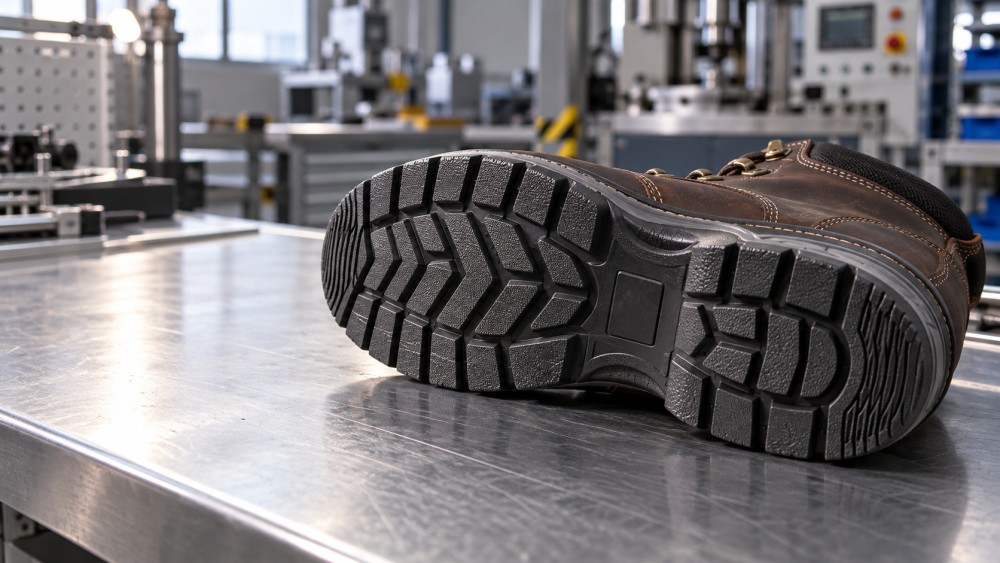
Look closely at the heel strike area, the ball of the foot, and the toe. These zones often wear differently. Flattened lugs, smooth patches, and channels worn nearly closed can reduce the sole’s ability to manage surface contamination. Packed mud or embedded debris can also obscure the remaining tread, so inspect after cleaning rather than judging a dirty sole.
Do not apply a generic minimum tread depth to every safety boot. Tread designs and intended surfaces differ. Use the manufacturer’s wear indicators or published limits where available. Without them, visibly smooth load-bearing areas or substantial loss of the original tread pattern warrant assessment and replacement planning; do not wait for a slip to confirm the problem.
Cracks, crumbling, and changes in material
Check the forefoot flex area, heel, and exposed midsole. Deep cracks, missing chunks, crumbling material, or an unusually sticky or swollen surface suggest more than ordinary abrasion. Material deterioration can also occur during storage, so an older, lightly worn pair is not automatically a safe spare.
Surface marks are not all equally serious. A shallow cosmetic mark differs from a crack that opens during normal flexing or exposes another layer. Where the depth or cause is uncertain, take the footwear out of hazardous use until the manufacturer or a competent assessor can evaluate it.
Separation and uneven support
Inspect the joint between the sole and upper all the way around each boot. An opening at the toe or heel can catch on steps, admit contamination, and progress under repeated flexing. Do not pull aggressively on the sole to test its bond.
Set both boots on a flat surface and look for pronounced leaning, a collapsed heel, or unequal wear. Uneven support may change how the foot sits even when some tread remains. Also check inside: a compressed footbed may be replaceable, but a collapsed structural midsole is a different problem and cannot be corrected simply by adding an insole.
Match the warning sign to the next action
A change in grip deserves attention, but it does not prove that sole wear is the only cause. Cleaning residues, an oil leak, a new floor coating, or a different work area can change traction. Replacing footwear must not become a substitute for controlling the floor hazard. Avoid deliberately testing questionable boots by sliding or walking across a contaminated surface.
Why the same sole lasts differently across workplaces
On rough concrete, abrasion can gradually flatten the contact areas. Outdoor work may add cuts from sharp aggregate and repeated exposure to mud. In kitchens and processing areas, fats, cleaning agents, and wet floors make material compatibility and tread cleanliness especially important. A sole that performs adequately in one setting may be unsuitable in another before it looks heavily worn.
Heat and chemicals require particular care. A resistance marking does not mean unlimited resistance to every temperature, substance, concentration, or exposure duration. Check the model’s intended use and the manufacturer’s instructions after an exposure rather than assuming the sole remains protective because it has not visibly melted or split.
Storage matters too. Some sole materials can deteriorate with age and environmental exposure even when tread remains deep. Avoid storing spare footwear in uncontrolled heat or damp conditions, and inspect stored pairs before issuing them. The purchase date is useful for tracking stock, but it is not a reliable substitute for condition checks.
Can the soles be replaced, or does the whole pair need replacing?
Resolable construction is necessary, but it is not enough by itself. A repairer’s ability to attach a new sole does not establish that the repaired footwear will retain its original protective performance. Safety footwear is assessed as a complete construction, including the relationship between the outsole, midsole, upper, and protective components.
Consider resoling only when the manufacturer supports it for that model and an approved repair route is available. Before authorizing the work, confirm:
- The model is eligible. Obtain model-specific guidance rather than assuming all stitched or welted boots can be safely resoled.
- The remaining boot is sound. The upper, seams, lining, fastening system, heel structure, and protective components must remain suitable for service.
- The replacement specification is appropriate. Sole material, tread, bonding method, and any relevant electrical or other protective properties must be addressed by the approved process.
- The repair has a defined acceptance check. Establish who checks the completed footwear and what documentation accompanies its return to work.
Replace the complete pair when the model is not approved for resoling, the required repair route is unavailable, or deterioration extends beyond the replaceable sole. Damage involving a toe cap, penetration-resistant component, or structural upper generally requires a broader replacement decision, not merely new tread.
Household glue, improvised patches, and cutting new grooves into worn soles are not appropriate ways to restore safety footwear. They can alter the construction without demonstrating restored grip, bond strength, or protective performance. A repair that looks secure is not necessarily a validated safety repair.
Do not confuse insoles, midsoles, and outsoles
The removable insole or footbed sits beneath the foot. The outsole contacts the floor, while the midsole, where present, contributes cushioning and structure between them. These parts have different failure modes and replacement options.
A worn removable footbed may cause discomfort while the outsole remains serviceable. Conversely, a fresh footbed cannot restore smooth tread or repair a deteriorating midsole. Before buying replacement inserts, establish which layer is causing the problem. New discomfort can also result from fit, changed duties, or damage inside the boot.
Use inserts permitted by the footwear manufacturer, especially where electrical properties or other specified protective characteristics matter. An aftermarket insert may change fit and internal clearance; it should not be treated as a universal upgrade for safety footwear.
Build a replacement process that does not depend on guesswork
For issued footwear, record the model, issue date, work area, inspection findings, and reason for retirement. Describe the actual failure—such as heel tread loss, forefoot cracking, or sole separation—rather than writing only “worn out.” This makes it easier to distinguish normal abrasion from a model that is poorly matched to the task.
Use those records to forecast purchasing needs, not to impose a fixed service life on every wearer. Repeated early tread loss may justify reviewing sole suitability or work practices. Recurrent chemical damage calls for checking compatibility and exposure controls, rather than simply ordering the same footwear more frequently.
Keep a clear route for reporting defects and obtaining a suitable replacement before the next hazardous task. Where one boot deteriorates much faster than the other, assess both and follow manufacturer guidance on repair or replacement; mixing an old boot with a different replacement can create mismatched support and traction. The practical trigger remains the same: once protective performance is doubtful, stop using the affected footwear for the hazard rather than waiting for a calendar deadline.


