
Which footwear sole materials provide the best slip resistance?

Which footwear sole materials provide the best slip resistance?
Choosing footwear sole materials for slip resistance requires more than comparing rubber, polyurethane and thermoplastic compounds. Grip depends on the interaction between material properties, tread geometry and the contact surface, as well as contaminants such as water or oil. For technical evaluators, standardized test results and representative operating conditions are essential to a meaningful comparison. This article examines how common sole materials perform, which factors influence traction and what to consider when assessing footwear for specific environments.
The short answer is that a well-formulated rubber outsole is often a strong starting point for demanding wet or oily environments. Certain polyurethane and thermoplastic compounds can also perform well, but their suitability depends on formulation and tread design. No material family is reliably the most slip-resistant on every floor. A sole that grips a wet tile in a laboratory may behave differently on an oily kitchen floor, a dusty warehouse surface or ice.
What different outsole materials can—and cannot—tell you
The name of a polymer identifies a useful starting category, not a traction rating. Fillers, plasticizers, processing conditions, hardness and surface texture all affect the finished compound. The comparison below is therefore best used to build a shortlist, not to approve a shoe.
Rubber: a flexible platform for demanding surfaces
Rubber outsoles are widely used where grip and durability both matter. Natural and synthetic rubbers can be compounded to balance flexibility, abrasion resistance, temperature response and resistance to particular contaminants. Nitrile rubber, for example, is often considered when oil resistance is important.
There is an important distinction between oil resistance and slip resistance on oil. A compound that resists swelling or degradation after oil exposure does not automatically generate sufficient friction on an oily floor. Evaluators should request evidence for both properties if workers face repeated oil contact.
Rubber can also be relatively heavy, and a formulation chosen for abrasion or heat resistance may not deliver the same grip as one optimized for another environment. For technical comparisons, ask for the specific compound identification and completed-footwear test results rather than accepting “rubber sole” as a performance description.
Polyurethane: lightweight, but formulation and ageing matter
Polyurethane, commonly abbreviated to PU, is attractive for work footwear because it can combine low weight, cushioning and wear resistance. Some shoes use a softer PU midsole with a denser PU or rubber outsole, allowing the manufacturer to address comfort and ground contact separately.
PU outsoles can provide useful slip resistance when the compound and tread are designed for the intended floor. However, performance varies considerably among formulations. Certain PU materials can also be susceptible to hydrolysis during prolonged storage or exposure to moisture and heat. That is a durability concern rather than proof of poor initial grip, but a degrading sole should not remain in service.
For footwear stored before distribution, ask the supplier about storage conditions, expected shelf life and inspection guidance. A fresh sample test alone does not answer how the construction will perform after storage or extended wear.
TPU and other thermoplastics: design freedom with trade-offs
Thermoplastic polyurethane, or TPU, is used in outsoles where designers want abrasion resistance, detailed moulding and structural support. Thermoplastic rubber and other thermoplastic elastomers cover a broad range of formulations and can also be engineered for flexible footwear.
Their behaviour depends heavily on the grade and operating temperature. A firm outsole may wear well but make less effective contact with an uneven or smooth contaminated surface than a more compliant alternative. Conversely, a softer compound is not automatically safer: the tread may deform, clog or wear down too quickly. Ask for tests on the finished shoe, especially when a compound has been selected primarily for appearance or abrasion resistance.
EVA and leather: know where the material sits
Ethylene-vinyl acetate, or EVA, is often used for cushioning because it is lightweight. In footwear intended for challenging surfaces, it is commonly paired with a separate traction layer. When a specification says “EVA sole,” check whether EVA actually contacts the ground or whether a rubber or other outsole provides the tread.
Leather can suit formal footwear, but a smooth leather contact surface is generally a poor starting point for wet or contaminated floors. A suitable rubber outsole or traction insert may change the practical choice, provided the complete construction is evaluated. In either case, appearance and slip resistance need to be considered together rather than treated as separate late-stage decisions.
Why tread design can overturn a material comparison
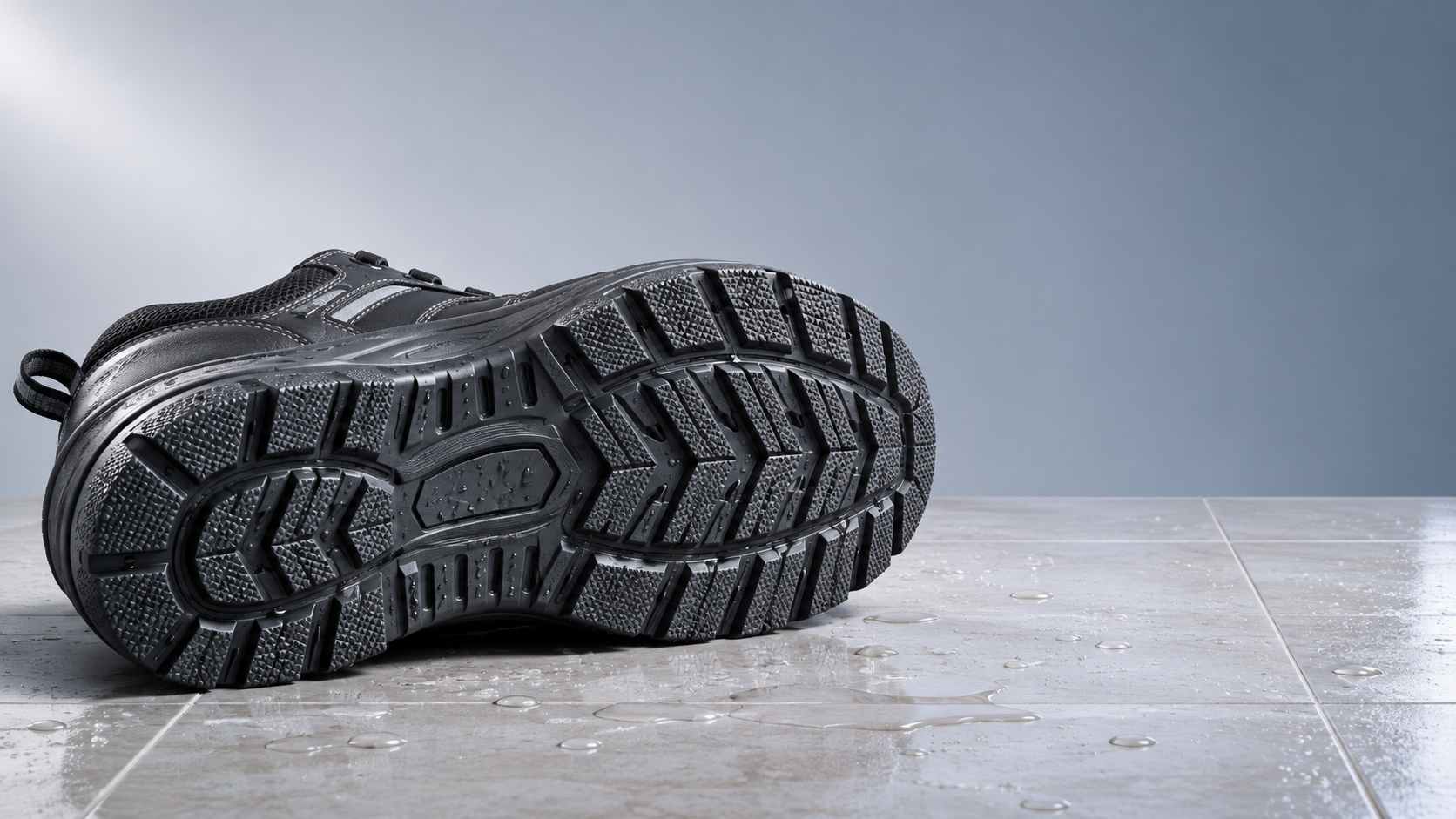
A sole must make effective contact with the floor. On a wet surface, channels and edges can help move liquid away from contact areas. On rough outdoor ground, larger lugs may engage with the terrain. These are different design problems: an aggressive hiking tread is not necessarily a good kitchen tread, particularly if its pattern retains debris or offers limited contact on smooth tile.
Geometry also changes during use. Worn edges, flattened lugs and clogged grooves can alter traction long before the upper looks damaged. A tread that is difficult to clean may be unsuitable in food processing even if its initial laboratory result is promising. Conversely, a very open pattern designed to shed debris may not suit every smooth floor.
Hardness deserves the same caution. A softer compound may conform more readily to surface irregularities, but hardness alone is not a proxy for friction. Contact area, compound chemistry, temperature and contamination all interact. Compare hardness measurements only when the method and test conditions are known, and use them to explain results—not replace slip testing.
Match the test to the working environment
The most useful specification starts with the exposure, not the material. Identify the floor, the contaminant and the movement that creates risk. A person turning while carrying a load may challenge the outsole differently from someone walking in a straight line. Temperature, cleaning chemicals and the rate at which the tread collects debris also matter.
- Commercial kitchens: Assess representative wet and greasy floor conditions, cleanability and the durability of the compound after contact with cleaning products.
- Warehouses and production areas: Distinguish between dry concrete, polished coatings, dust and localized oil exposure. One test surface may not represent the whole site.
- Outdoor work: Consider mud, loose ground and wet hard surfaces separately. A lug design that sheds soil may behave differently on smooth walkways.
- Cold environments: Check flexibility and traction at relevant temperatures. Ice and ice with a water film are particularly challenging; ordinary wet-floor performance should not be assumed to predict ice performance.
Where ice is a principal hazard, dedicated ice-traction footwear or removable traction devices may be worth evaluating alongside conventional soles. Their suitability depends on the site: devices that help on ice may introduce other risks or damage on indoor floors. The transition between outdoor and indoor surfaces should be part of the assessment.
Read slip-test reports beyond the headline claim
A coefficient of friction is useful only in context. It describes the result of a particular test configuration; it is not a universal safety score. When comparing reports, check whether the footwear was tested against the same surface, contaminant, movement and loading conditions. A higher figure obtained under a different method does not necessarily mean better performance in the intended workplace.
In occupational footwear, ISO 13287 specifies a laboratory method for testing slip resistance. ISO 20345 and ISO 20347 address safety and occupational footwear requirements respectively, including slip-related provisions in their applicable editions. The exact requirements and markings depend on the edition and product classification, so evaluators should verify the version used and the rules relevant to the destination market. ASTM F2913 is another footwear slip-resistance test method; its results should not be treated as interchangeable with results from a different protocol without careful comparison.
A credible report should identify the tested product and its outsole, the method and edition, test conditions and results. Check whether the report covers the production construction being considered—not merely a similar-looking sample or a standalone material plaque. If a supplier changes the compound, mould, manufacturing site or outsole geometry, determine whether existing evidence remains applicable or retesting is needed.
Standard tests provide a controlled comparison, not a guarantee against slipping. A site-specific trial can add useful evidence when the floor or contamination is not well represented by the standard. Such trials need a safe protocol, consistent observations and appropriate supervision; deliberately creating uncontrolled slip hazards is not a substitute for a laboratory test.
Build a specification that survives production and wear
Once candidate shoes have passed an initial screen, the decision shifts from “Which material grips?” to “Can this construction deliver consistent grip over its intended life?” That question connects design with manufacturing. A small tread alteration for aesthetics, a substitute compound or a change in moulding conditions can affect the contact surface even when the catalogue description remains unchanged.
Ask suppliers to document the outsole compound designation, tread drawing, manufacturing process and relevant tolerances. Agree on how substitutions will be communicated and which changes trigger review. If recycled or bio-based content is proposed, evaluate the actual finished compound rather than assuming that sustainability claims establish—or compromise—traction. Traceability and repeatable formulation matter as much as the material’s origin.
Include practical acceptance and replacement criteria in the footwear programme. Depending on the application, these may involve checking for tread wear, cracking, separation, contamination that cannot be removed or signs of material degradation. The appropriate limits should come from the shoe design, supplier guidance and workplace risk assessment, not an arbitrary tread-depth figure applied to every product.
The strongest decision is therefore rarely “rubber versus PU” in isolation. Shortlist complete outsole constructions, compare valid test reports under matching conditions, and then check whether the leading candidates remain suitable after wear, cleaning and storage. That approach gives technical teams a defensible basis for balancing traction with comfort, appearance and manufacturability—without confusing a material label with evidence of performance.


