Modular Home Furniture: Cost vs Flexibility in 2026

In 2026, modular home furniture has moved beyond visual appeal and entered the center of sourcing strategy. Buyers now compare not only style, but also unit economics, lead time stability, material efficiency, and reconfiguration potential.
As living patterns evolve, modular home furniture offers a practical answer to smaller spaces, faster product refresh cycles, and rising customization expectations. Yet flexibility often carries hidden costs in engineering, packaging, connectors, and after-sales support.
Understanding that trade-off is essential. A low initial price may create long-term replacement waste, while highly adaptable systems may require stronger quality control and clearer compatibility standards across collections.
Defining Modular Home Furniture in the 2026 Market
Modular home furniture refers to products built from standardized units that can be combined, expanded, separated, or replaced. Common categories include sofas, wardrobes, shelving, storage walls, dining systems, and hybrid work-from-home setups.
Unlike fixed furniture, modular systems are designed around repeatable dimensions, interchangeable components, and scalable layouts. This structure supports aesthetic consistency while allowing users to adapt rooms without buying entirely new pieces.
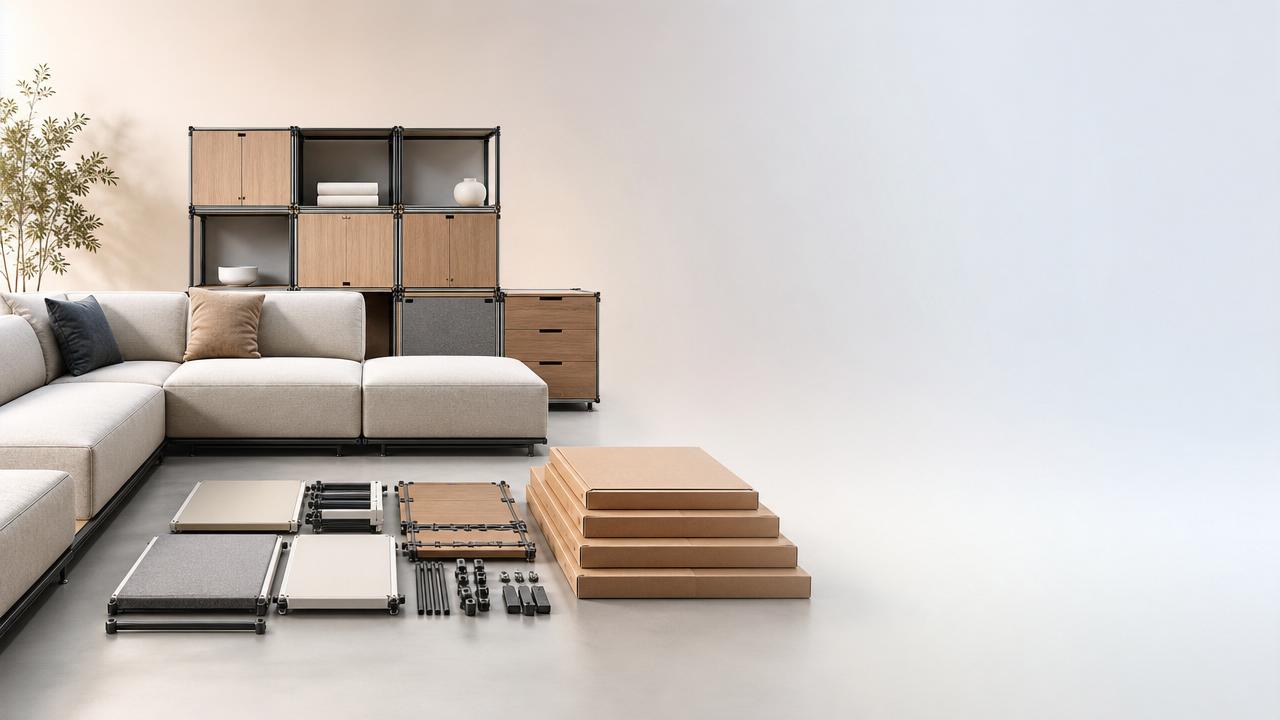
In 2026, the concept has broadened. It now includes flat-pack engineering, tool-free assembly, smart hardware integration, sustainable material selection, and digital configuration systems that improve planning accuracy before production starts.
For the broader furnishing industry, modular home furniture also connects design language with manufacturing discipline. It depends on precision cutting, connector durability, surface consistency, and packaging logic as much as on visual creativity.
Industry Background and Current Signals Shaping Decisions
Several market shifts explain why modular home furniture remains a key topic in 2026. Cost pressure and flexibility demand are increasing at the same time, forcing closer evaluation of the full value chain.
- Material volatility continues to affect wood panels, metal frames, foam, and upholstery inputs.
- Urban living spaces require compact formats and multifunctional room planning.
- Consumers expect personalization without accepting excessive delivery delays.
- Retail channels need collections that work both online and in physical showrooms.
- Sustainability standards increasingly reward repairable and upgradeable furniture systems.
These signals matter across the combined sectors of home furnishing, textiles, craftsmanship, and lifestyle products. Modular home furniture sits at that intersection, where fabric choices, structural hardware, and spatial design all influence commercial performance.
Cost Structure: Where Modular Home Furniture Saves and Spends
The cost question is more complex than comparing ticket prices. Modular home furniture may reduce some expenses while increasing others, depending on category, engineering maturity, and order scale.
Areas where cost advantages often appear
- Better container utilization through compact packaging
- Reduced inventory risk through reusable core modules
- Lower replacement cost when only one component needs renewal
- Easier SKU extension using common frames or carcass structures
Areas where hidden cost can increase
- Connector systems require testing, tolerance control, and reliable suppliers
- More components can raise assembly error risk and claims management
- Custom configuration tools need accurate data and maintenance
- Visual consistency across batches becomes harder with mixed-material systems
For many businesses, the strongest financial value of modular home furniture appears over time rather than at first purchase. Lifecycle efficiency often outweighs simple ex-factory comparisons, especially when products are expected to evolve with interiors.
Flexibility Value Across Design, Supply Chain, and Use
Flexibility is the main promise of modular home furniture, but it delivers value in several different ways. Not every project needs all of them, so alignment with product strategy is essential.
Design flexibility
Modules allow one design language to serve multiple room sizes and lifestyle needs. A sofa can become sectional seating, a storage unit can scale vertically, and a desk wall can combine work and living functions.
Commercial flexibility
A modular range supports broader assortment planning without fully separate product development. Shared materials, hardware, and dimensions can simplify sourcing decisions while still expanding market coverage.
Operational flexibility
When engineered well, modular home furniture helps absorb forecast uncertainty. Core units can be stocked more efficiently, while finish or accessory options remain adaptable closer to the final order stage.
User flexibility
End users increasingly value furniture that moves with them. Reusable modules match rental living, family growth, hybrid work, and seasonal layout changes better than fixed-format products.
Typical Product Categories and Suitability Levels
Not every category benefits equally from modularization. Performance depends on structural demand, frequency of reconfiguration, and tolerance for visible joints or hardware.
This variation shows why modular home furniture should not be treated as a universal formula. The best results come from applying modular logic where spatial and commercial benefits are strongest.
Practical Evaluation Points Before Commitment
A strong decision framework should compare immediate savings with long-term flexibility. The following points help test whether modular home furniture will deliver durable value.
- Check whether modules share true dimensional standards across future collections.
- Review connector cycles, load performance, and repeated assembly durability.
- Compare packaging efficiency against damage risk and assembly complexity.
- Confirm finish consistency across replacement parts and later production batches.
- Assess digital configuration accuracy, especially for online selling environments.
- Estimate spare-part support requirements and after-sales documentation needs.
Attention to these details reflects the broader industry direction highlighted by GLC: craftsmanship must meet design ambition. Modular home furniture succeeds when engineering discipline supports aesthetic flexibility without creating service instability.
Strategic Outlook for 2026 and Next Steps
In 2026, modular home furniture is best understood as a system decision, not simply a style choice. Its real value appears when cost control, design adaptability, logistics efficiency, and sustainability goals are considered together.
The most effective path is to identify categories with clear reconfiguration demand, standardize the components that truly repeat, and avoid unnecessary complexity that only inflates engineering and service cost.
For market planning, start with a focused comparison: fixed-format versus modular home furniture across packaging, replacement rate, SKU efficiency, and customer use cycles. That analysis creates a more reliable basis for product roadmap decisions.
As global aesthetics continue to merge with practical living needs, modular home furniture will remain central to modern furnishing strategy. The winners will be solutions that balance beauty, compatibility, durability, and supply chain realism.