Space-Saving Home Furniture Ideas That Actually Work

Finding effective space-saving home furniture can transform small rooms from cramped to comfortable. This guide explores practical ideas that actually work, from multifunctional pieces to smart layout choices, helping research-driven readers understand how design, craftsmanship, and usability come together to maximize living space without sacrificing style.
For buyers, specifiers, and sourcing teams tracking home furnishing trends, space-saving home furniture is no longer a niche category. It sits at the intersection of urban living, compact floor plans, material innovation, and manufacturing precision.
In practical terms, successful compact furniture must solve at least 3 problems at once: footprint reduction, daily usability, and visual order. If one of those fails, the product may look clever in a catalog but underperform in real homes, serviced apartments, or flexible residential projects.
From the perspective of Global Living & Craftsmanship, the real value lies in understanding how design ideas translate into production details. Joinery strength, hardware cycles, upholstery choice, and packaging efficiency often determine whether a space-saving concept actually works in the market.
Why Space-Saving Home Furniture Matters in Today’s Market
Demand for smaller yet better-organized living environments is rising across apartments, co-living units, student housing, and urban renovation projects. In many cases, usable room sizes fall within a 20–70 square meter range, which puts heavy pressure on every furniture decision.
That shift changes how product developers, retailers, and sourcing managers evaluate furniture. A standard sofa or bed is no longer judged only by appearance. It is assessed by storage volume, clearance needs, fold mechanism durability, and whether one item can replace 2 or 3 separate products.
The Core Drivers Behind Compact Furnishing Demand
- Urban homes increasingly require dual-use rooms, such as living rooms that become guest rooms within 2–5 minutes.
- Consumers expect hidden storage to reduce visual clutter without adding extra cabinets.
- Developers and furnished-rental operators look for products that reduce SKU complexity while improving occupancy appeal.
- International buyers favor flat-pack or knock-down structures that lower freight volume by roughly 20%–40% compared with fully assembled items.
What “Actually Works” Means in Real Use
In this category, performance is measurable. A lift-up storage bed should open smoothly under repeated use, a fold-out dining table should remain stable at full extension, and a nesting table set should stack with minimal friction and surface wear.
As a rule of thumb, products in compact interiors need at least 60–90 centimeters of circulation clearance in primary movement zones. If a mechanism needs too much opening space, the promised space-saving benefit disappears during daily use.
Key Evaluation Dimensions
For research-driven readers, 4 dimensions matter most: occupied footprint, transformed footprint, storage capacity, and maintenance frequency. These factors create a stronger buying framework than style language alone.
Space-Saving Home Furniture Ideas That Deliver Real Results
Not every compact furniture trend deserves equal attention. The most reliable categories are those with clear ergonomic logic, repeatable manufacturing methods, and a low learning curve for users. Below are the formats that consistently perform well across multiple home furnishing markets.
1. Storage Beds and Lift-Up Bed Frames
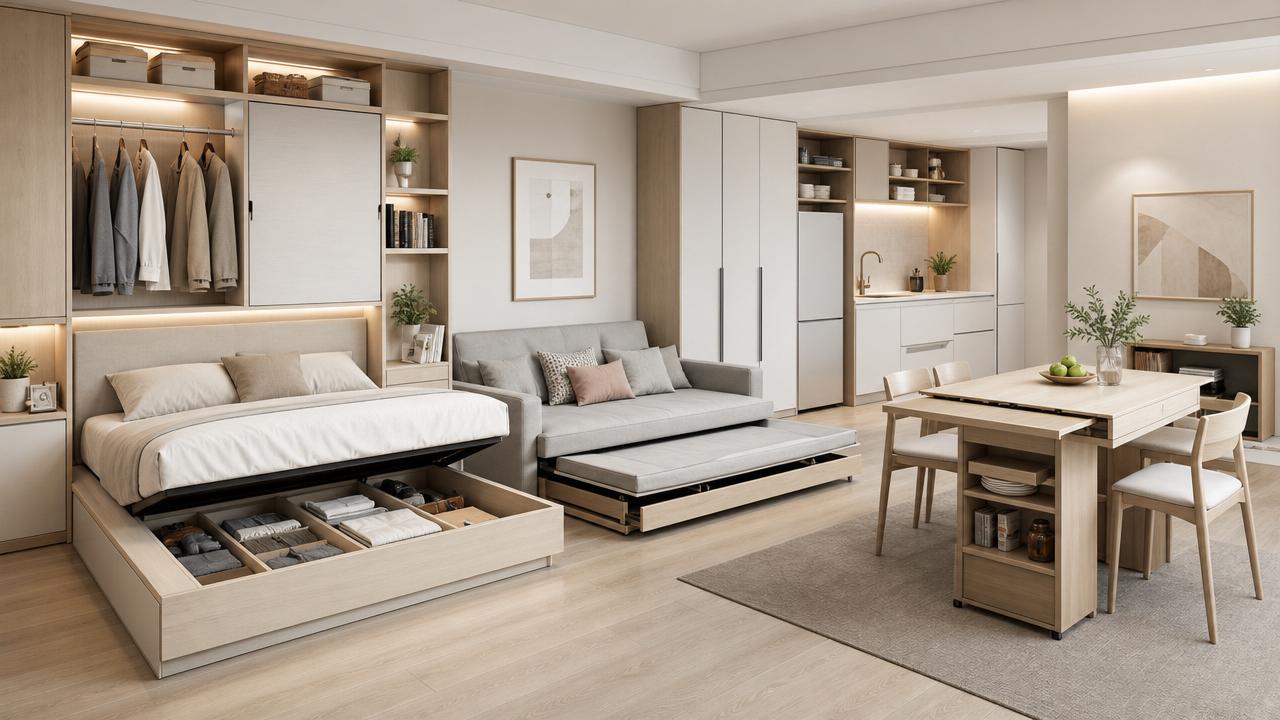
Beds occupy one of the largest footprints in the home, so integrating storage here creates immediate efficiency. A queen-size lift-up bed can add a large concealed compartment without increasing room area, making it useful for seasonal textiles, luggage, or infrequently used items.
For sourcing, focus on gas-lift quality, hinge reinforcement, panel thickness, and edge finishing. A weak lifting system often becomes evident within 6–12 months of regular use, especially when storage loads are uneven.
2. Sofa Beds Built for Daily Conversion
A sofa bed works best when conversion is simple enough for daily use. Good designs shift between seating and sleeping in 2–3 steps, without removing too many cushions or exposing fragile connectors.
In hospitality-inspired residential setups, the strongest models balance a seat depth of about 52–60 centimeters with a sleep surface that supports adult use. This is where frame stability and upholstery abrasion resistance become commercially important.
3. Extendable Dining Tables and Drop-Leaf Formats
Dining zones often serve 2 people daily and 4–6 people occasionally. Extendable tables solve that mismatch. A drop-leaf or butterfly-extension design can reduce the permanent footprint while preserving hosting flexibility.
The mechanism should lock securely in both compact and extended states. Surface alignment matters as well; if panel seams are uneven by more than a few millimeters, the table quickly feels low grade in both retail and project applications.
The table below compares common space-saving home furniture categories by use case, operating complexity, and sourcing considerations.
The main takeaway is that the best-performing pieces are not always the most complex. In many homes, a mechanically simple item with reliable hardware outperforms a highly engineered product that demands too much user effort or maintenance.
4. Wall-Mounted Desks and Fold-Down Work Surfaces
As remote and hybrid work continue to influence residential design, wall-mounted desks offer a strong answer for homes without a dedicated study. When closed, they preserve floor area; when opened, they create a focused work zone in a narrow footprint.
However, this category depends heavily on installation context. Buyers should review wall compatibility, bracket load ratings, and cable management. A work surface may look minimal, but it still needs to support laptops, notebooks, and task lighting on a daily basis.
5. Modular Shelving and Vertical Storage Systems
When floor area is limited, vertical strategy becomes essential. Shelving systems that use wall height effectively can increase storage without crowding circulation. In compact interiors, using the upper 30%–40% of wall space often creates a cleaner room than adding another floor cabinet.
For manufacturers and procurement teams, modularity also helps. Shared components across 3–5 layout variations can reduce tooling complexity and support more flexible merchandising or project customization.
How to Choose the Right Space-Saving Home Furniture
Selection should begin with room behavior, not product novelty. The best furniture for a studio apartment may be unsuitable for a family living room, even if both spaces are small. Decision-makers should evaluate function frequency, user profile, and installation constraints before choosing a format.
Measure Beyond Footprint
A common mistake is measuring only the closed size of furniture. Buyers also need the open dimension, service clearance, drawer travel path, and surrounding movement zone. In compact rooms, a 10–15 centimeter miscalculation can affect the full usability of a piece.
Review Materials Through a Use-Intensity Lens
Compact furniture often experiences more movement and transformation than static furniture. Hinges, slides, connectors, and casters therefore deserve extra scrutiny. Fabric selection matters too, particularly in sofa beds where seating and sleeping both accelerate wear cycles.
Material and Build Priorities
- Stable frame construction for repeated opening and closing.
- Hardware rated for frequent use, especially in daily-transform items.
- Surface finishes that resist scratching in tight circulation zones.
- Textiles or leather alternatives chosen for cleanability and abrasion resistance.
- Packaging engineered to reduce transit damage on moving parts and corners.
The following table outlines a practical decision framework for evaluating space-saving home furniture across residential and trade contexts.
This framework helps shift the discussion from decorative preference to operational suitability. For B2B decision-makers, that means fewer returns, better installation outcomes, and stronger product-market fit.
Match the Product to the End User
A single adult in a city apartment may prioritize hidden storage and fast conversion. A family may prioritize safety edges, easier cleaning, and durable hardware. A furnished rental operator may prioritize assembly efficiency, spare part availability, and consistent finish batches across larger orders.
Common Mistakes, Supply Chain Risks, and Practical Implementation Tips
Even strong concepts can fail because of poor execution. In the compact furniture segment, mistakes often happen during specification, prototyping, packaging, or installation planning rather than at the idea stage.
Frequent Selection Mistakes
- Choosing a product based on closed dimensions only, without checking open-use clearance.
- Ignoring daily ergonomics in favor of clever transformable features.
- Underestimating hardware quality in fold, lift, and extension systems.
- Selecting finishes that show impact damage quickly in high-contact zones.
Supply Chain and Quality Control Considerations
From a manufacturing and sourcing viewpoint, transformable furniture introduces more variables than static items. Tolerance management, mechanism sourcing, and carton protection all become more important. A small alignment issue at the factory can become a visible functional defect after delivery.
For international buyers, sample review should include at least 4 checkpoints: assembly time, mechanism smoothness, finish consistency, and packaging resilience. If possible, ask for opening-and-closing demonstrations over repeated cycles rather than relying only on still photos.
A Simple 5-Step Implementation Process
- Map room dimensions and identify fixed obstacles such as doors, windows, and outlets.
- List 2–3 primary functions the room must support every week.
- Shortlist furniture that combines those functions with minimal conversion effort.
- Review material, hardware, and packaging details before order confirmation.
- Plan maintenance, spare parts, and installation instructions for after-sales stability.
Why Craftsmanship Still Matters
Space-saving home furniture succeeds when design intelligence meets dependable craftsmanship. Precision drilling, balanced hinges, reinforced stress points, and upholstery tailored to movement zones are not minor details. They are the difference between a product that photographs well and one that performs for years.
That is why market research should extend beyond style trends. Understanding how global aesthetics connect with production capability, material science, and practical living patterns leads to better sourcing decisions and more resilient product portfolios.
Final Takeaways for Research-Driven Buyers
The most effective space-saving home furniture is functional, durable, and easy to live with. Products such as storage beds, sofa beds, modular shelving, extendable tables, and fold-down workstations can all work well when dimensions, hardware, and user habits are properly aligned.
For procurement teams, retailers, and product developers, the winning approach is to compare concepts through measurable criteria: clearance, conversion steps, storage gain, maintenance needs, and logistics efficiency. That approach reduces risk while improving consumer satisfaction in compact living environments.
If you are evaluating new compact living categories, refining a sourcing strategy, or looking for deeper insight into furniture craftsmanship and market direction, GLC can help bridge design intent with manufacturing reality. Contact us to get a tailored solution, discuss product details, or explore more space-saving home furniture insights for your business.