Multifunctional Home Furniture for Small Space Planning

Multifunctional Home Furniture for Small Space Planning
As urban living footprints shrink, technical evaluation must move beyond stylish claims and focus on measurable performance.
Multifunctional home furniture has become central to small space planning because it combines storage, ergonomics, durability, and adaptable use.
Convertible sofas, modular storage, foldable tables, and work-living systems now require careful checks of structure, materials, and supply-chain logic.
Why a Checklist Matters for Multifunctional Home Furniture
Compact interiors fail when furniture is selected only by size. Daily transitions reveal weak hinges, unstable frames, and uncomfortable proportions.
A checklist makes multifunctional home furniture easier to compare across design, craftsmanship, safety, logistics, and long-term living value.
It also connects aesthetics with industrial standards. A beautiful unit must still open smoothly, carry weight, resist wear, and support healthy posture.
For small apartments, studios, guest rooms, and hybrid work corners, multifunctional home furniture should reduce clutter without creating operational friction.
Core Checklist for Evaluating Multifunctional Home Furniture
- Measure the active footprint, including drawers, pull-out beds, rotating tops, and walking clearance during every functional position.
- Check the transformation sequence, ensuring one person can fold, slide, lift, or convert the unit without awkward force.
- Verify load ratings for seats, shelves, beds, hinges, wall mounts, and extension mechanisms before approving compact layouts.
- Inspect joint quality, fastener density, panel thickness, and edge banding to judge the durability of multifunctional home furniture.
- Test ergonomic dimensions, including seat depth, table height, mattress support, backrest angle, and reach distance.
- Confirm material performance through abrasion resistance, moisture tolerance, formaldehyde compliance, textile pilling, and surface scratch resistance.
- Assess storage logic, making sure compartments match real items such as bedding, shoes, books, devices, and cleaning tools.
- Review maintenance access, especially replaceable hardware, washable covers, removable panels, and visible service points.
- Evaluate packaging volume, flat-pack efficiency, assembly steps, spare parts, and damage protection during long-distance distribution.
- Compare visual neutrality, color durability, texture quality, and adaptability across seasonal décor or future room changes.
This checklist helps separate practical multifunctional home furniture from pieces that look clever but perform poorly after repeated use.
Convertible Seating and Sleeping Systems
Sofa beds, daybeds, and sleeper chairs are often the first category considered for compact homes.
The main evaluation point is not only sleeping area. It is the balance between sitting comfort and mattress support.
High-quality multifunctional home furniture in this category should use reinforced frames, stable folding mechanisms, and breathable upholstery.
Check whether cushions deform after compression. Also inspect whether the sleeping surface has gaps, hard bars, or uneven pressure zones.
Compact sofa beds should leave enough surrounding clearance. A unit that blocks wardrobes or doors can reduce the value of the entire room.
Modular Storage for Flexible Living
Storage is the strongest advantage of multifunctional home furniture, but only when internal planning matches real daily behavior.
Modular cabinets, storage benches, lift-top coffee tables, and under-bed units should support quick access without visual noise.
Measure internal depth and shelf adjustability. Shallow spaces waste volume, while overly deep cabinets hide items and increase clutter.
For multifunctional home furniture with drawers, inspect runners, anti-tip design, and load stability when compartments are fully extended.
A good storage system should divide frequently used items, seasonal objects, and rarely handled supplies into clearly accessible zones.
Foldable Tables and Transforming Work Surfaces
Foldable dining tables, wall-mounted desks, nesting tables, and lift-top platforms support hybrid use in small interiors.
The priority is stability. A work surface that shakes during typing, writing, or dining weakens trust immediately.
Multifunctional home furniture for work zones should consider cable routing, device heat, monitor distance, and comfortable forearm support.
For wall-mounted tables, inspect anchor requirements and wall compatibility. Lightweight panels still need secure installation and clear load limits.
Foldable hardware must close quietly and lock firmly. Soft-close features improve safety, especially in narrow kitchens or shared rooms.
Integrated Work-Living Systems
Small homes increasingly combine rest, study, work, fitness, and entertainment in one room.
Integrated multifunctional home furniture helps manage this overlap through zoning, concealment, acoustic softness, and flexible surfaces.
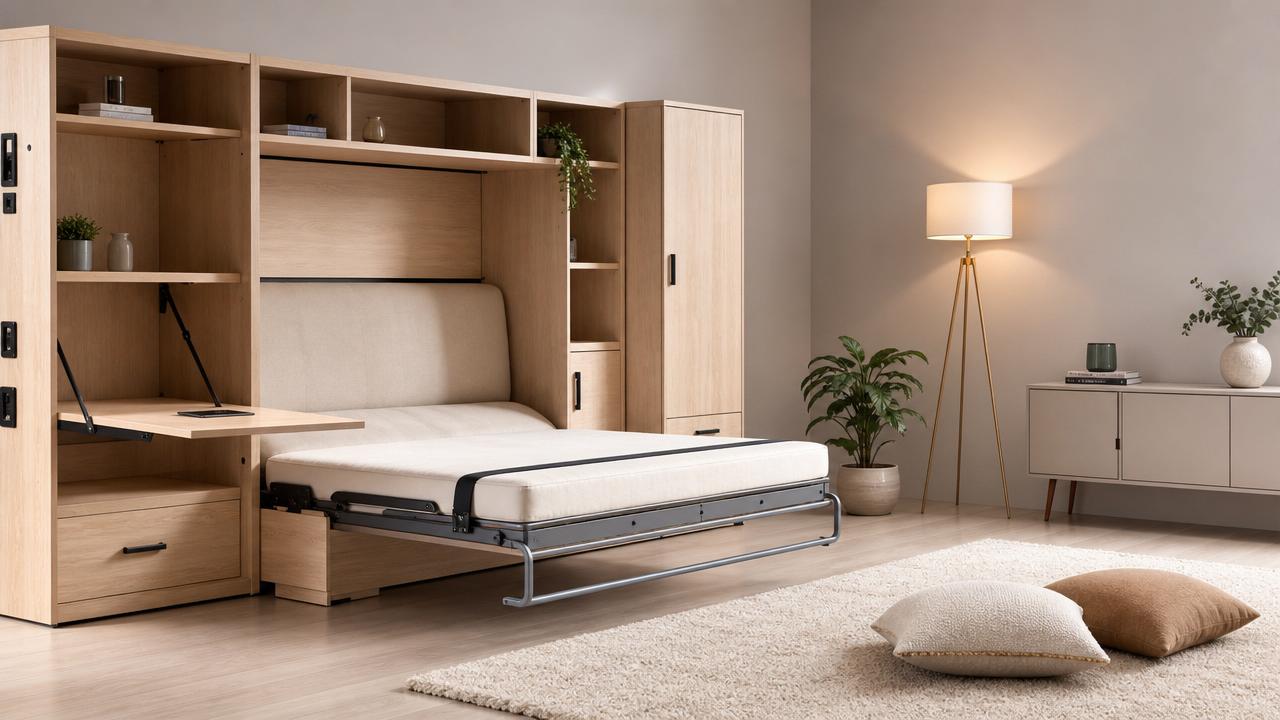
Examples include wardrobe-desk combinations, Murphy beds with shelving, media walls with storage, and room dividers with fold-out functions.
Evaluate whether each function can operate independently. A bed should not make a desk unusable for the entire day.
Lighting placement matters. Poor light turns multifunctional home furniture into a compromise, especially for reading, grooming, cooking, or remote work.
Material and Craftsmanship Standards to Check
Small-space furniture receives frequent contact because every piece performs multiple tasks.
Materials must therefore resist abrasion, stains, moisture, repeated opening, and compression better than single-purpose furniture.
- Select engineered boards with verified emission performance, consistent density, clean drilling, and stable screw-holding capacity.
- Choose upholstery fabrics with tested rub counts, colorfastness, pilling resistance, and easy-clean finishes for daily conversion use.
- Review metal hardware for corrosion resistance, smooth movement, locking accuracy, and fatigue performance after repeated cycles.
- Inspect visible seams, stitched corners, laminate edges, and panel alignment because compact rooms reveal small defects quickly.
Craftsmanship is not only visual. In multifunctional home furniture, it determines safety, service life, and user confidence.
Commonly Overlooked Risks
Ignoring Clearance During Conversion
Many layouts measure furniture only in its closed state. This causes blocked paths, unusable drawers, or awkward movement after conversion.
Underestimating Hardware Fatigue
Hinges, gas lifts, sliders, and rotating plates carry the real workload in multifunctional home furniture. Weak parts shorten service life.
Overloading Hidden Storage
Storage beds and lift-top units often receive heavy items. Without clear load limits, panels may bend and mechanisms may fail.
Choosing Looks Over Daily Rhythm
A product that requires too many steps may remain unused. Effective compact furniture must fit natural habits, not disrupt them.
Practical Execution Guide
- Map the room by function first, separating sleeping, eating, working, storage, dressing, and movement zones before selecting furniture.
- Record both closed and open dimensions, then mark clearance lines on the floor to simulate real operation.
- Prioritize two or three essential functions per piece instead of demanding every product solve every problem.
- Request material specifications, hardware cycle data, emission references, care instructions, and assembly documentation before final evaluation.
- Test repetitive motions, including opening, folding, lifting, sliding, sitting, and cleaning, to expose weak design details.
- Plan future flexibility by choosing modular elements that can be moved, expanded, reconfigured, or repaired without replacing everything.
This process makes multifunctional home furniture easier to compare across price levels and design styles.
It also supports greener decisions by reducing waste, avoiding premature replacement, and encouraging repairable construction.
Supply-Chain Logic Behind Better Small-Space Furniture
Strong multifunctional home furniture depends on coordinated design, material sourcing, machining precision, packaging, and after-sales part availability.
Flat-pack systems must balance shipping efficiency with structural strength. Excessive part reduction can weaken joints or complicate assembly.
Hardware standardization is valuable. Common hinges, runners, and connectors improve repair potential and reduce long-term ownership risk.
Sustainable choices include certified boards, recycled textiles, replaceable covers, low-VOC finishes, and compact packaging with recyclable protection.
The best compact solutions unite global aesthetics with production discipline, making daily living easier without sacrificing craftsmanship.
Conclusion and Next Action
Multifunctional home furniture is not a trend label. It is a practical response to smaller homes and more flexible lifestyles.
A reliable decision should combine measurements, ergonomic review, material testing, hardware inspection, and realistic daily-use simulation.
Before choosing multifunctional home furniture, create a room function map, confirm active dimensions, and check every moving component.
The right pieces save space, reduce clutter, extend usability, and support quality living through thoughtful design and dependable craftsmanship.