Smart Footwear Features That Matter in Daily Use

For technical evaluators, smart footwear now earns attention through dependable daily performance, not novelty. The market is shifting toward features that improve comfort, data quality, durability, and scalable production.
That shift matters across the broader lifestyle industry. Footwear is no longer judged only by style. It is judged by how sensors, materials, software, and craftsmanship work together in real conditions.
In this environment, smart footwear must support walking, commuting, work routines, exercise transitions, and long wear cycles. Reliable function, easy charging, strong materials, and consistent manufacturing now shape commercial value.
Why smart footwear is moving from novelty to daily-use utility
The strongest trend signal is practical adoption. Buyers and product teams increasingly ask whether smart footwear performs well after repeated steps, sweat exposure, charging cycles, and surface changes.
Another signal is integration across sectors. Footwear innovation now connects textiles, embedded electronics, ergonomic design, and supply chain discipline. This makes smart footwear a cross-industry evaluation topic.
Consumer expectations have also matured. Many users no longer want complicated dashboards. They want smart footwear that feels natural, collects meaningful data, and requires minimal maintenance.
As a result, technical review standards are becoming stricter. Comfort, signal stability, battery endurance, and wash resistance now matter as much as app features or design language.
The features that matter most in daily smart footwear use
Not every feature creates real value. The most important smart footwear capabilities are the ones that remain useful, accurate, and comfortable during everyday movement.
1. Pressure sensing that stays accurate over time
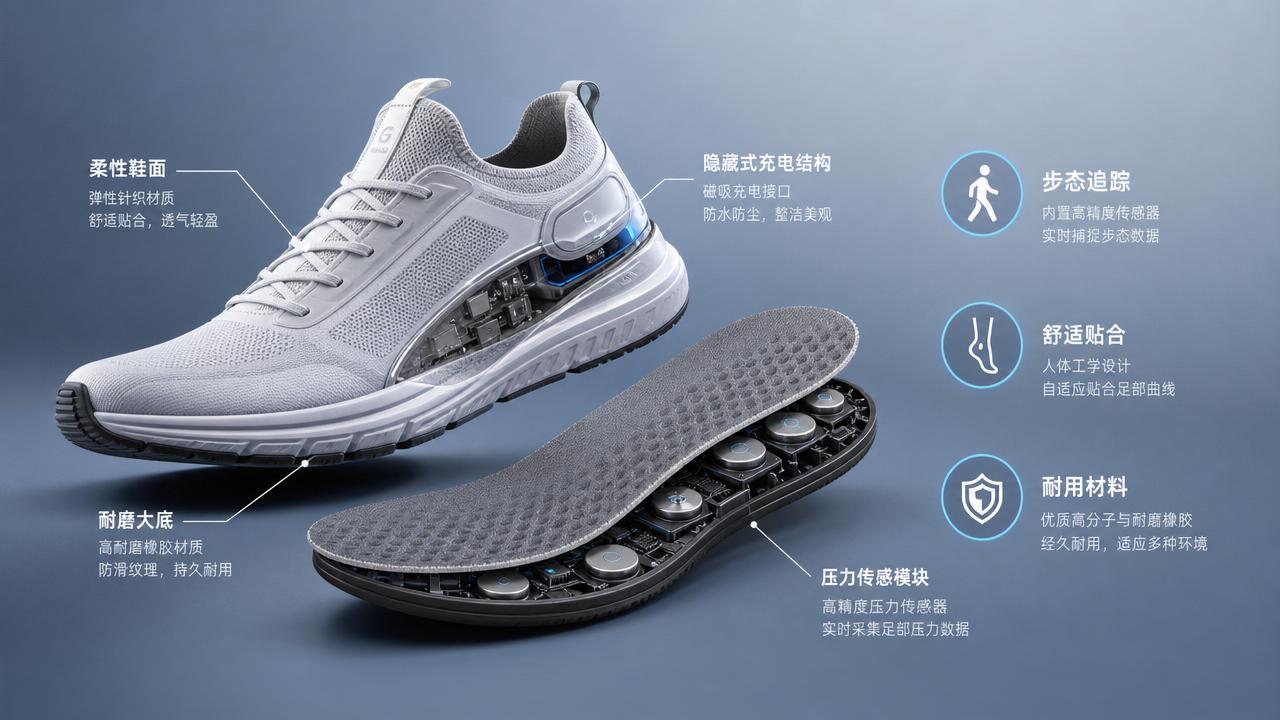
Pressure sensors are central to many smart footwear systems. They help detect step patterns, weight distribution, impact load, and balance changes during walking or standing.
What matters is repeatable accuracy. Sensors must resist drift after prolonged compression. If readings change too quickly, the data loses practical value for daily assessment.
2. Gait tracking that reflects real environments
Good gait tracking should work beyond controlled settings. Smart footwear must capture useful motion data on pavement, office floors, stairs, and uneven urban surfaces.
The best systems distinguish between walking styles, stride variations, and fatigue signals. They avoid exaggerated claims and focus on consistent pattern recognition.
3. Comfort that does not fight the technology
A smart shoe fails if electronics create stiffness, hotspots, or weight imbalance. Daily-use smart footwear should feel unobtrusive during long wear.
Placement of modules, cushioning strategy, upper flexibility, and insole contour all influence acceptance. The smartest feature is often the one a wearer barely notices.
4. Battery life that matches real routines
Battery performance is one of the clearest decision factors. Smart footwear should last through realistic daily cycles rather than ideal laboratory conditions.
Fast charging, stable output, and clear power management matter more than peak specifications alone. Frequent charging quickly reduces convenience and long-term adoption.
5. Durable materials and sealed construction
Daily smart footwear faces sweat, dust, flexing, and temperature shifts. Materials must protect electronics without sacrificing breathability or comfort.
Strong value often comes from hybrid construction. Bio-synthetic leather, engineered textiles, abrasion-resistant outsoles, and protected circuitry support longer service life.
What is driving demand for better smart footwear features
Several forces are shaping the next phase of smart footwear. They explain why practical features now outrank experimental additions in many product evaluations.
How these smart footwear trends affect design, production, and market fit
The impact begins at product design. Teams can no longer treat sensors as add-ons. Smart footwear must be engineered from the start as a balanced system.
Material selection now affects signal quality, flex behavior, thermal comfort, and assembly durability. This creates closer links between electronic design and traditional shoemaking craft.
Production is also changing. Smart footwear requires tighter process consistency than standard fashion footwear. Small deviations in placement or bonding can alter comfort and sensor reliability.
Commercial fit depends on clarity. Products with too many weak functions often underperform. Smart footwear with fewer, stronger features usually communicates value more effectively.
- Design teams must align electronics with human movement patterns.
- Material teams must balance breathability, sealing, and flex resistance.
- Production teams must control module placement and bonding precision.
- Market teams must define useful everyday benefits, not abstract innovation.
The practical checkpoints that deserve closer attention
When assessing smart footwear, several checkpoints help separate strong products from feature-heavy concepts. These areas directly influence user satisfaction and lifecycle performance.
Sensor reliability under repeated use
- Check calibration stability after repeated compression cycles.
- Test signal consistency across different walking surfaces.
- Review performance after moisture exposure and temperature changes.
Human-centered comfort and fit
- Measure weight distribution, not total weight alone.
- Observe pressure points around embedded components.
- Assess long-wear comfort during standing and walking transitions.
Battery and charging realism
- Compare claimed battery life with mixed-use scenarios.
- Evaluate charging speed and connector durability.
- Review battery performance after repeated charge cycles.
Manufacturing consistency
- Check variation between batches, not only sample prototypes.
- Inspect seam quality, adhesive stability, and sensor alignment.
- Confirm that performance survives standard wear testing.
How to judge the next move in smart footwear development
The next stage of smart footwear will likely favor quiet intelligence. Products will become less visibly technical while improving comfort, data trust, and service life.
That means evaluation should move beyond headline features. The better question is whether smart footwear solves a real daily problem with repeatable performance.
Where focused action creates the most value
A useful next step is to benchmark smart footwear against real daily-use conditions. Test data should include step repetition, charging frequency, moisture exposure, and comfort after extended wear.
It is also worth comparing feature count with feature reliability. In many cases, the best smart footwear is not the most complex. It is the most dependable.
Across the global lifestyle and craftsmanship landscape, smart footwear stands out when technology respects design, material science, and production discipline. That balance is what turns innovation into durable market relevance.
For deeper industry observation, GLC continues tracking how smart footwear, advanced materials, and intelligent manufacturing reshape everyday products through the lens of quality living and practical craftsmanship.