Multifunctional Home Furniture for Small-Space Layouts

Why multifunctional home furniture matters in compact living
As urban homes shrink and daily routines diversify, multifunctional home furniture has moved from trend to necessity.
A sofa may host guests by day, store bedding by night, and support remote work between both moments.
That shift matters across the broader lifestyle industry.
It connects design aesthetics, material engineering, ergonomic planning, and manufacturing craftsmanship in one practical decision.
For readers tracking home, office, and lifestyle supply chains, multifunctional home furniture reveals how smarter products create better spatial value.
It also shows how quality living now depends on adaptability, not only on decoration.
How to judge small-space layouts before choosing furniture
Not every compact room needs the same multifunctional home furniture strategy.
The right layout depends on movement paths, storage pressure, user habits, and the number of functions a room must support.
A studio apartment usually needs visual openness and hidden storage.
A family apartment often needs safer edges, faster cleanup, and surfaces that switch between dining, study, and play.
Small-space planning should begin with three judgments:
- How many activities happen in one room each day
- How often furniture must transform or fold away
- Whether storage should be visible, hidden, or modular
This scenario-based approach makes multifunctional home furniture easier to compare beyond appearance alone.
Scenario one: studio apartments needing flexible day-to-night transitions
Studio homes demand the highest level of multifunctional home furniture performance.
One area may serve as lounge, bedroom, dining spot, and workstation within the same twenty-four hours.
Here, convertible furniture should minimize physical effort and visual clutter.
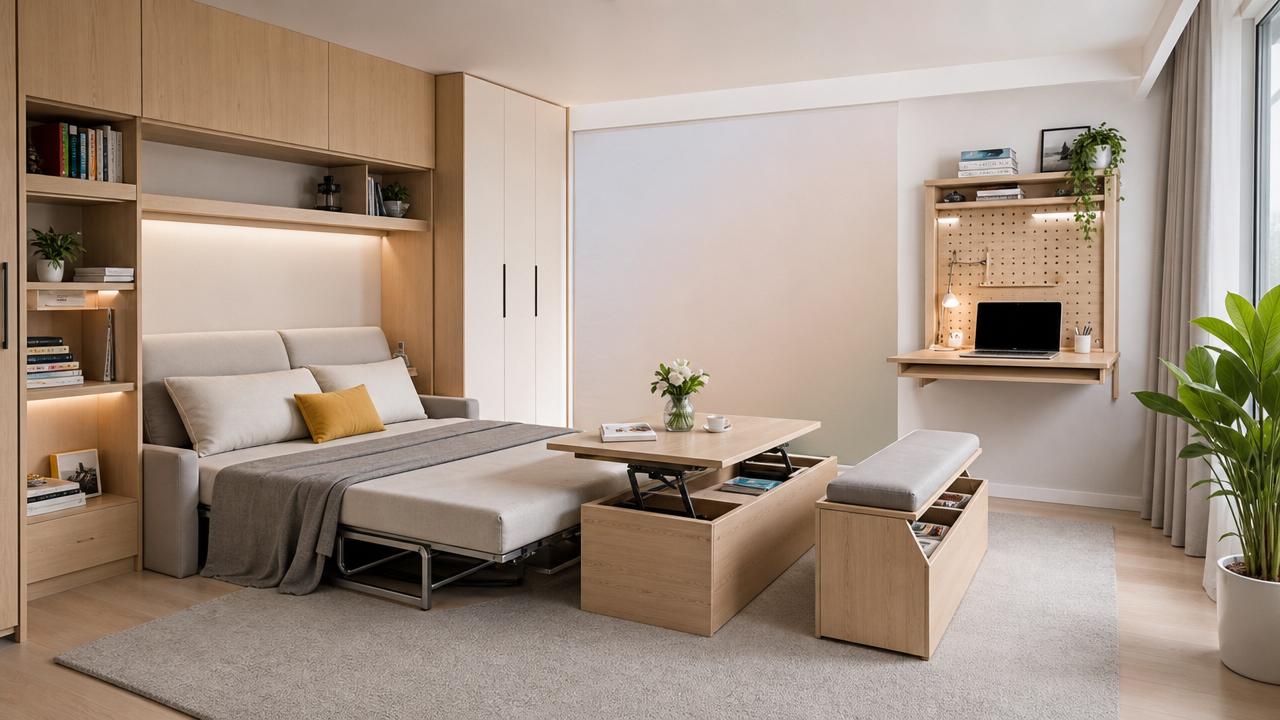
Good examples include sofa beds with integrated linen compartments, nesting tables, lift-top coffee tables, and wall-mounted fold desks.
The key judgment point is transition speed.
If a product takes too many steps to open, close, or reorganize, daily use drops quickly.
Material choice also matters.
Durable hinges, stable frames, and stain-resistant upholstery support repeated conversion without compromising aesthetics.
What to prioritize in a studio layout
- Furniture with hidden storage under seats or platforms
- Slim silhouettes that preserve sightlines
- Lightweight modules that can be moved alone
- Neutral finishes that reduce visual fragmentation
Scenario two: family homes balancing storage, safety, and shared use
In small family homes, multifunctional home furniture must support multiple users with different routines.
The same bench may hold shoes, act as entry seating, and hide seasonal accessories.
A dining table may become a homework surface or hobby station after meals.
Safety becomes a stronger filter in this scenario.
Rounded corners, anti-tip structures, soft-close drawers, and easy-clean surfaces matter more than dramatic transformation features.
Storage zoning is another core judgment point.
Multifunctional home furniture works best when it separates daily essentials from occasional-use items.
That helps maintain order without making each room feel overfilled.
Some curated references may appear as 无 within trend reports, but practical evaluation still depends on fit, durability, and use frequency.
Scenario three: hybrid living and working in one compact interior
Remote and hybrid work have changed what multifunctional home furniture needs to achieve.
A compact home now often includes video calls, focused work, casual dining, and rest in overlapping zones.
The best furniture in this setting supports ergonomic posture while disappearing when work ends.
Fold-out desks, console-to-table systems, storage ottomans, and shelving dividers are especially useful.
The core judgment point is whether the room can mentally reset.
If work equipment remains visually dominant, even well-designed multifunctional home furniture may fail to support comfort.
Craftsmanship quality becomes important here.
Stable mechanisms, cable-aware detailing, and durable surfaces improve long-term usability far more than novelty alone.
How different small-space scenarios change furniture needs
Practical selection advice for multifunctional home furniture
Choosing multifunctional home furniture should combine design taste with industrial logic.
A beautiful piece loses value when hardware fails or dimensions ignore movement space.
Use these checks before buying
- Measure open and closed dimensions, not only footprint.
- Test how many motions are needed for conversion.
- Check joint strength, frame stability, and drawer glide quality.
- Match upholstery or surfaces to real maintenance habits.
- Prefer modular systems when needs may change within one year.
If style research includes outside references such as 无, keep focus on performance evidence, not just inspirational images.
Common mistakes when planning compact rooms
A frequent mistake is assuming every multifunctional home furniture item saves space.
Some oversized transformers require extra clearance and become less efficient than simple fixed pieces.
Another mistake is overvaluing storage volume while ignoring access convenience.
Deep compartments often become dead zones for items rarely reached.
Many layouts also fail because visual density is overlooked.
Too many mixed finishes, bulky arms, or thick table bases can make a small room feel tighter.
Finally, craftsmanship is often underestimated.
In compact interiors, furniture gets used harder, moved more often, and noticed more closely.
That means construction quality directly affects both comfort and lifecycle value.
Next steps for smarter small-space decisions
Multifunctional home furniture works best when chosen through real scenarios, not through generic trends.
Start by mapping daily activities, room overlap, storage pain points, and preferred visual style.
Then compare options by transformation ease, material durability, ergonomic comfort, and long-term adaptability.
For readers following global craftsmanship and lifestyle innovation, this category offers a clear view of where design intelligence meets manufacturing quality.
The strongest small-space solutions are never only compact.
They are efficient, refined, and built to support better living every day.